


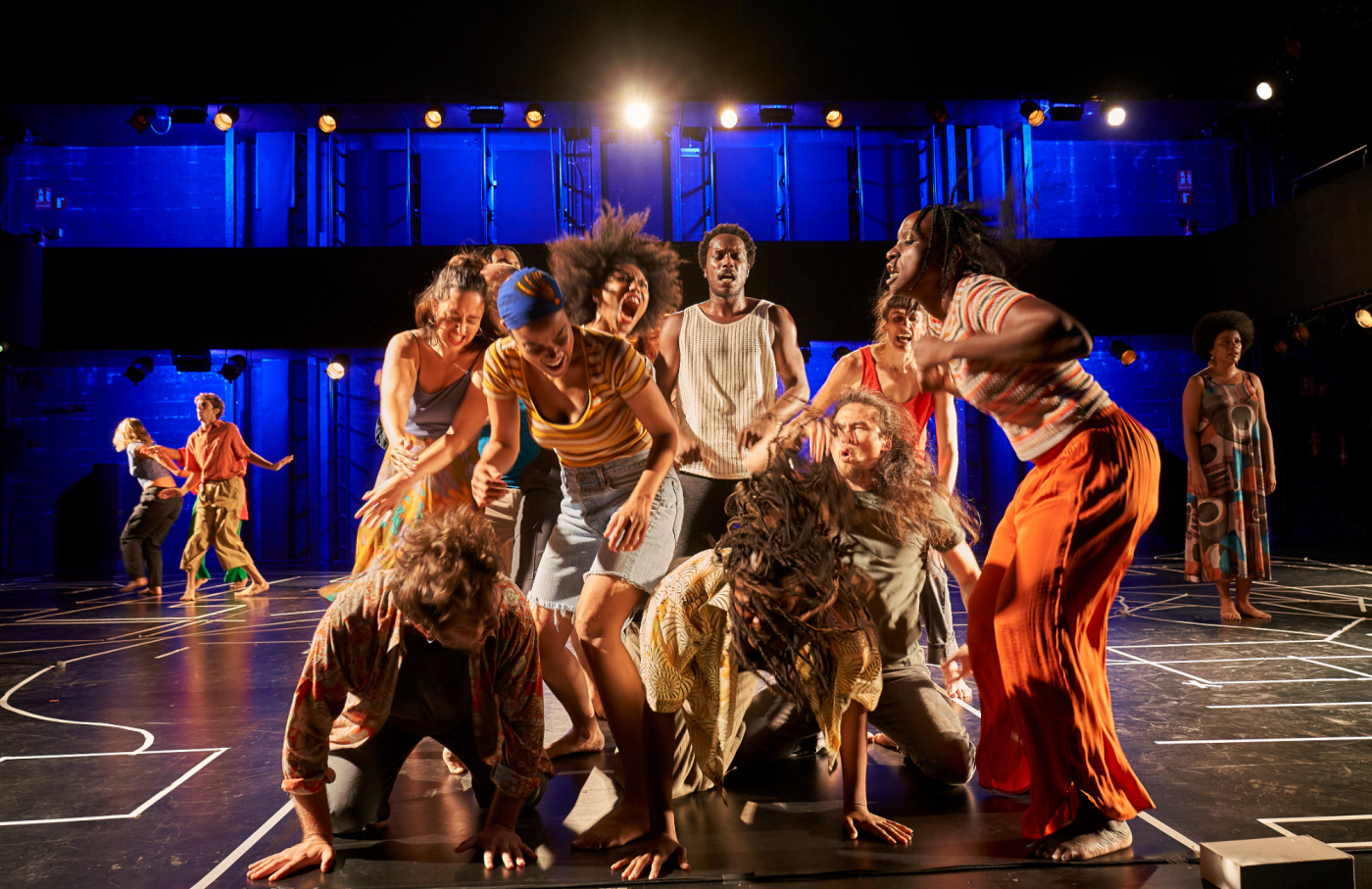
Urban dramaturge Gerardo Salinas is currently working with director Junior Mthombeni and a group of "city artists" in Barcelona on a new creation called What the foc?!. They are using the Urban Dramaturgy method, a technique inspired by the working process for MAPping. Gerardo explains what this method involves.
As you could read in my previous blog post, we are working with 17 people on the What the foc?! creation. We started with twenty, but due to timing issues, not everyone could participate in the entire process. It is crucial for every project to create a meeting place and safe space, so that everyone can find their place based on their own reality and disciplines.
Next, we embarked on an investigation. Who leaves what traces in the city? For this, we use the Urban Dramaturgy method, which originated from the MAPping project that took place in 2017 in Brussels.
Urban dramaturgy: what the foc?
What exactly does urban dramaturgy mean? I like to explain it as follows: Cities do not really exist. They are a performance, repeated more or less daily, by the same people, who do more or less the same things – or do not do them. Each performer constantly creates and recreates the city. Without these people, without us, without you, the city is a meaningless set.
That's why everything we do is so important. And everything we don't do is full of meaning too. If we all decided to leave the set, the city would no longer be the same physical and mental space. At the same time, every time we walk through the geography of the city, we scatter our origins, dreams, and feelings.
We create a mestizo layer of senses. In this mixture lies the city's past, present, and future. That's the "fire." Cities are fires glowing in the distance, drawing us in. Large European cities, such as Barcelona or Brussels, have a stronger attraction due to their history, colonial past, and asymmetric global relations. They attract people seeking a better future, safety, knowledge, love, and dreams. Or people who, without knowing it, follow the natural wealth of their land. And thus, we find ourselves in these fires.
And when you come to a campfire, the first thing you do is tell a story. These shared stories, told by someone with whom we share a life, touch us much deeper than a documentary or a Wikipedia entry. And we jump into the fire. We walk through it. And that fire becomes a part of us, and we become a part of it. All these stories feed the fire. All these lives and dreams.
The fire can give you strength and light, but it can also devour you. Or both at the same time. It is in this exercise of closeness and distance that we inhabit and create the city. What stories feed the city's fire today? Who is illuminated and who is devoured?
How does it work in practice?
For two and a half weeks, we first conducted an investigation in the city. Initially, this meant a walk where we, as a group, walked silently through the streets of Barcelona for five hours. During this walk, we carried out actions and observed the city and how it reacts to us. This collective experience became our first text and an opportunity to approach the specific way each of the performers feels, lives, and creates the city. It is an intimate and collective relationship.
We work on the level of the individual (micro), the group (meso), and politics (macro). These are the three areas of action in which we participate in the city. We introduced the temporal variant, based on the postulate that all actions take place in the past, present, and future. All the time, we produce and reproduce the collective story in which we participate.
This is how the material for What the foc?! was created. Foc is Catalan for "fire." We wonder what fire of stories and lives the city creates today.
Gerardo Salinas (KVS urban dramaturge)