


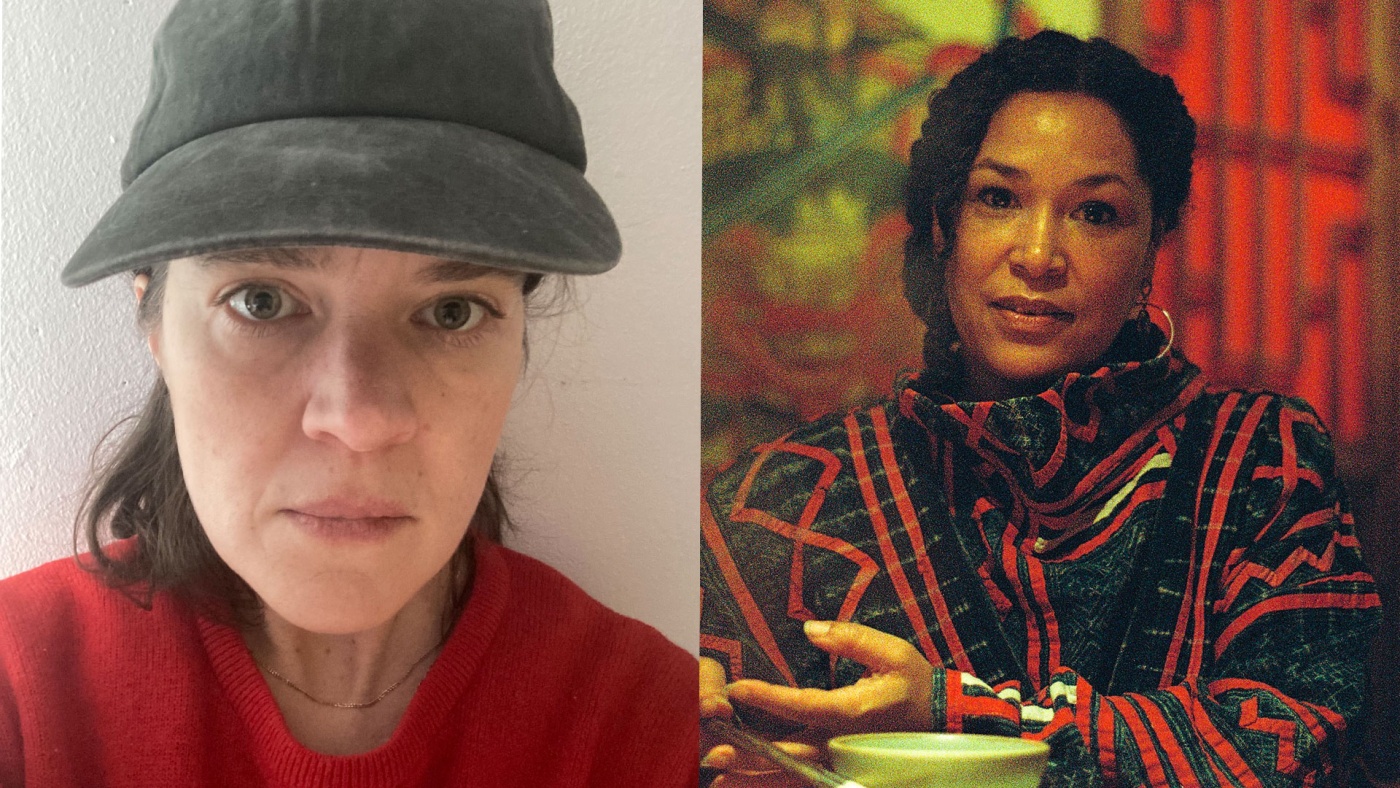
On a cold January day, I’m meeting Moya Michael and Charlotte Bouckaert at the spacious cafe of WIELS. We grab a coffee and settle at a table in a quiet corner.
You’re both developing a new creation for the upcoming season at KVS. Can you give a glimpse of what you’re working on?
Charlotte: “Like most of my work, I Never Looked Like That emerged from my interest in the tension between photography and performance. In the piece, I’ll be taking and projecting self portraits on stage.
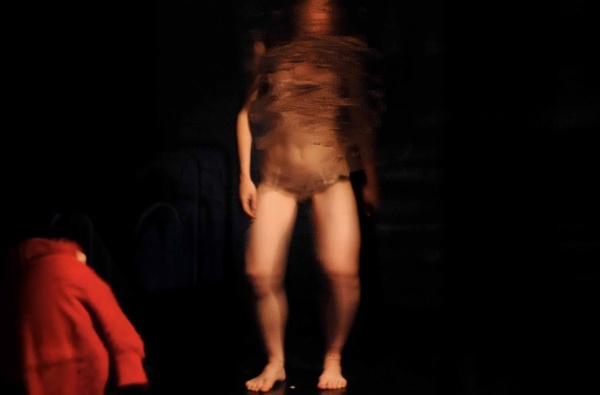
In doing so, I’m confronting myself as well as the audience with my ‘honest’ body. At the same time, there’s this performative act in taking a self portrait: it’s a pose. Drawing from Cindy Sherman’s work, the piece reflects on the representation of women’s bodies, but in a broader sense, it’s a work about perception, about looking and questioning what you think you’re seeing.”
Moya: “The piece I’m working on is an adaptation of the 2013 piece Darling, which I created together with Igor Shyshko. We met at P.A.R.T.S. in 1997, and ever since, our backgrounds have been a constant presence in our conversations: we’re the same age, but I grew up in apartheid South Africa, and Igor in post-Chornobyl soviet Belarus. In Darling we tracked the political history of our countries from the moment we were born, until we met. We did this through sound, which acted as a third dancer. We’ve always wanted to make another version of the duet, gathering performers from different backgrounds, cultures and political contexts. So we assembled a group of dancers from a younger generation to do just that.”
Both of your practices engage with the performance of the self, while exploring relationality – through the gaze, the presence, or the body of the other. How do these relationships between self and other, between performer and audience, manifest within your work?
Charlotte: “It’s a prominent question in this piece: how can I perform a self, while still saying something about more than just me on stage? I don’t see myself as a performer, but I use tools like text, sound and image, to play with the audience’s gaze, to make them conscious of their way of looking, to shift meaning.”
Moya: “As a dancer, part of one’s training is to interpret someone else’s way of moving or choreographing. Over time, I’ve started to feel increasingly comfortable improvising and inhabiting my own body. My work often engages with themes of ancestrality and cultural lineage. Although I recognize the impossibility of “performing” ancestrality, these questions are always present in my practice. I tend to think about the visual dimension of a piece from the very beginning, bringing in elements such as video, objects, and sound, so that I am really crafting an experience. In other words, I am more moving away from representation and toward an experience. This also shifts how I think about performance and about the relationship between self and other, or performer and audience: I am less interested in fixing an identity on stage, and more drawn to creating situations in which different bodies, gazes, and histories can move and affect one another.”
You’ve both explored the confines of the black box and brought your performances into the white cube. Art critic Claire Bishop observes a ‘grey zone’ in between these two. How do you experience (moving between) these different realms, and how do their boundaries shape your work?
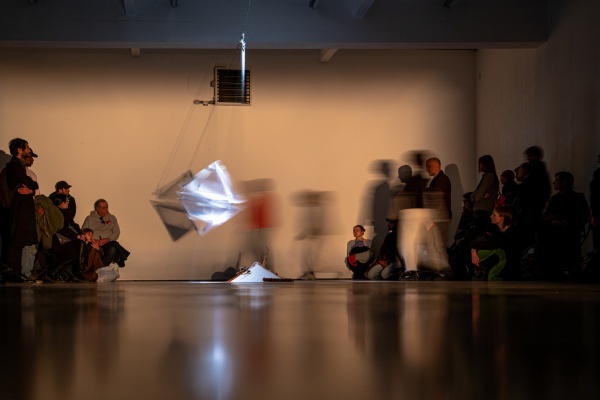
Moya: “While I usually try to dissolve the boundaries between the audience and the performer, for my last piece (It’s Like a Finger Pointing a Way to the Moon), the distance felt safer. In the museum, however, the audience was really close, almost part of the work.
That proximity felt better, strangely. It allowed the audience to walk around and touch the objects, to stay in the space after the performance. That sense of lingering, remaining with the residue of what they had witnessed, was really interesting to me. It opened up a whole new way of thinking – literally outside of the box.”
Charlotte: “In a black box, the conditions are mostly the same everywhere. When you perform in the museum, there’s indeed somewhat of a grey zone: you’re confronted with different codes that are not always clear. While this opens up many other ways of moving and interacting, you have to be very aware of how people navigate the space. For my latest piece The Photographer Left, They Told the Truth (2025), I put a closed box into the museum with a performer in it. People had to press a button, and a picture of the performer appeared on a screen next to the box. I didn’t want to explain too much, but I found that people needed that: many peopledidn’t notice or even believe that there was a performer inside, or felt uncomfortable to interact with the piece. In the black box, the question remains on how to cultivate a productive grey zone, how to invite people into my worlds.”
We’ve been talking about situating the self in relation to a broader context, and navigating the so-called grey areas. In a moment when we’re increasingly inclined to think in stark black-and-white terms, what role can artistic practices play in moving beyond that, in relating in a different way?
Charlotte: “A work needs to be open enough. Is it therefore less political? I don’t think so. I want to stand up for something, of course. But to me, this also means looking up from your phone on the metro, to notice the little things. That’s something I stand for, to look for poetry in the little things, to cultivate a poetic state of mind, an imagination, which makes you look differently. To take time for looking.”
Moya: “It is about the looking, indeed. I do think that underlying all of the horror and the wounds, I have to somehow find the poetry. Approaching it in a literal manner feels too easy. Salt, for example, is a recurring element in my work, because in most African traditions it is purifying, cleansing. It’s much more subtle, but that doesn’t mean it has no meaning. It’s just that some people won’t understand its meaning. And I’m not here to teach you to understand it. But I can invite you to look at it.”
Interview by Margot De Grave Loyson