


A Room of His Own
EVENING PROGRAMME
A Room Of His Own is a searing satire about pornography, power and the regulation of sexuality. At its centre is Andrea Dworkin, the radical feminist who fiercely campaigned against pornography in the 1970s. In this dark, sensual and comic trip, we delve into her contradictions.
From her bed, a fictional Dworkin takes us through a sleepless night, past decadent dreamscapes, the post-war promise of sexual freedom and the echoes of her struggle in our own time.
With Up Your Ass, young theatre-maker and director Nona Demey Gallagher had already made quite an impression at TheaterFestival 2024, where her work was described as a “rock-and-roll rollercoaster”.

In A Room Of His Own, iconic anti-pornography feminist Andrea Dworkin tumbles into the hellish world of pornography during a feverish dream. Overwhelmed by hallucinations, Dworkin is swept away like an Alice in Wonderland figure on a mental and moral journey, encountering several key historical figures along the way.
She crosses paths with the French writer and philosopher Marquis de Sade (1740–1814), notorious for his violent pornographic works, in which, from a libertine perspective, he argued that morality restrains humanity’s inherently sadistic nature. Playboy founder Hugh Hefner (1926–2017) also takes to the stage as a modern-day devil. The fashionable bachelor and “free thinker” transformed pornography from a taboo into a cultural product that became deeply embedded in Western mainstream media and society. In a garden that serves simultaneously as a childlike playground and an ominous nocturnal setting, a landscape unfolds in which male hunters search for their next prey.
The female childish Playboy bunny seems to have escaped from Disneyland to become the object of desire of the male visitor to the Playboy mansion.
— Paul B Preciado in Pornotopia (2019)
The performance is an anachronistic narrative in which biblical scenes intertwine with early pornographic films, while frivolous Rococo elements transform into symbols of post-war pop culture. This historical, thematic and formal clash brings together costume, set design, music and video to cast the representation and power dynamics of pornography throughout the centuries in a new light. Drawing on texts by Andrea Dworkin, Paul B Preciado and feminist literature, the performance creates a tension between discourse and theatrical humour, bringing issues such as violence, innocence and binarity within our sexual culture into sharp focus.
At a time when pornography is all around us, director Nona Demey Gallagher uses A Room Of His Own to take a critical look at the omnipresence of pornography and the ways in which it permeates our culture. Her focus is on the underlying ideologies and worldviews that drive pornography. The performance asks critical questions about the legacy of the sexual revolution and challenges audiences to consider how it shapes our understanding of gender, power and intimacy. In the theatre, the isolation of the individual screen viewer is disrupted by the audience’s collective experience. A Room Of His Own is therefore an invitation to stop being passive spectators of pornography and instead question our own position within this visual culture.
I don’t want to be moralistic. That doesn’t interest me. I’m placing different voices side by side. I want to see what happens when those logics collide.
— Nona Demey Gallagher in Different Class

Nona Demey Gallagher
Nona Demey Gallagher is a theatre-maker, director and performer.
WHO WAS ANDREA DWORKIN?
Andrea Dworkin was born in Camden, New Jersey, in 1946, into a progressive Jewish family. Her parents were outspoken leftists: her father was a teacher and socialist, while her mother was a fervent advocate of contraception and abortion rights. Her later feminism and activism therefore seem to have taken root early on. At the same time, the sexual abuse she experienced during her childhood and later life became an important driving force behind her work and contributed to the radicalisation of her anti-pornography views.
While studying at Bennington College, she was arrested in 1965 during a protest against the Vietnam War. During her detention in a New York women’s prison, she was subjected to a forced and particularly brutal internal examination, which caused bleeding for several days. Dworkin publicly testified about the experience in court. Her testimony sparked widespread outrage, although no formal charges followed.
After graduating, she moved to Amsterdam, where she met her first husband, Provo anarchist Cornelius Dirk de Bruin. Their relationship was extremely violent. After years of abuse, she left him and entered a period of poverty, homelessness and sex work. She eventually found support in writer Ricki Abrams, who introduced her to radical feminist literature that would form the basis of her later work, including Woman Hating (1972), which they wrote together.
In 1972, Dworkin returned to the United States, where she published her book and became active in anti-war and anti-apartheid movements. She gained recognition for her sharp, polemical writing style and joined radical feminist movements campaigning against sexual violence and pornography. She became a pivotal figure in the anti-pornography camp during the feminist sex wars, leading numerous protests, becoming a sought-after speaker and making several attempts to introduce legislation restricting pornography. At the heart of her work and activism was the struggle for women’s freedom and safety and against their dehumanisation. These convictions informed influential works such as Pornography: Men Possessing Women (1981) and Intercourse (1987), in which she denounced pornography as an expression of misogyny and unequal power relations that perpetuate discrimination against women.
In her private life, she lived with author John Stoltenberg from 1974 onwards. Although both identified as gay, they shared a close and enduring relationship. In 2005, Dworkin died at home of heart failure after a long period of illness.
Pornography incarnates male supremacy. It is the DNA of male dominance. Every rule of sexual abuse, every nuance of sexual sadism, every highway and byway of sexual exploitation, is encoded in it. It’s what men want us to be, think we are, make us into; how men use us; not because biologically they are men but because this is how their social power is organized.
— Andrea Dworkin in Pornography: Men Possessing Women
A QUICK DIVE INTO THE HISTORY OF THE FEMINIST SEX WARS
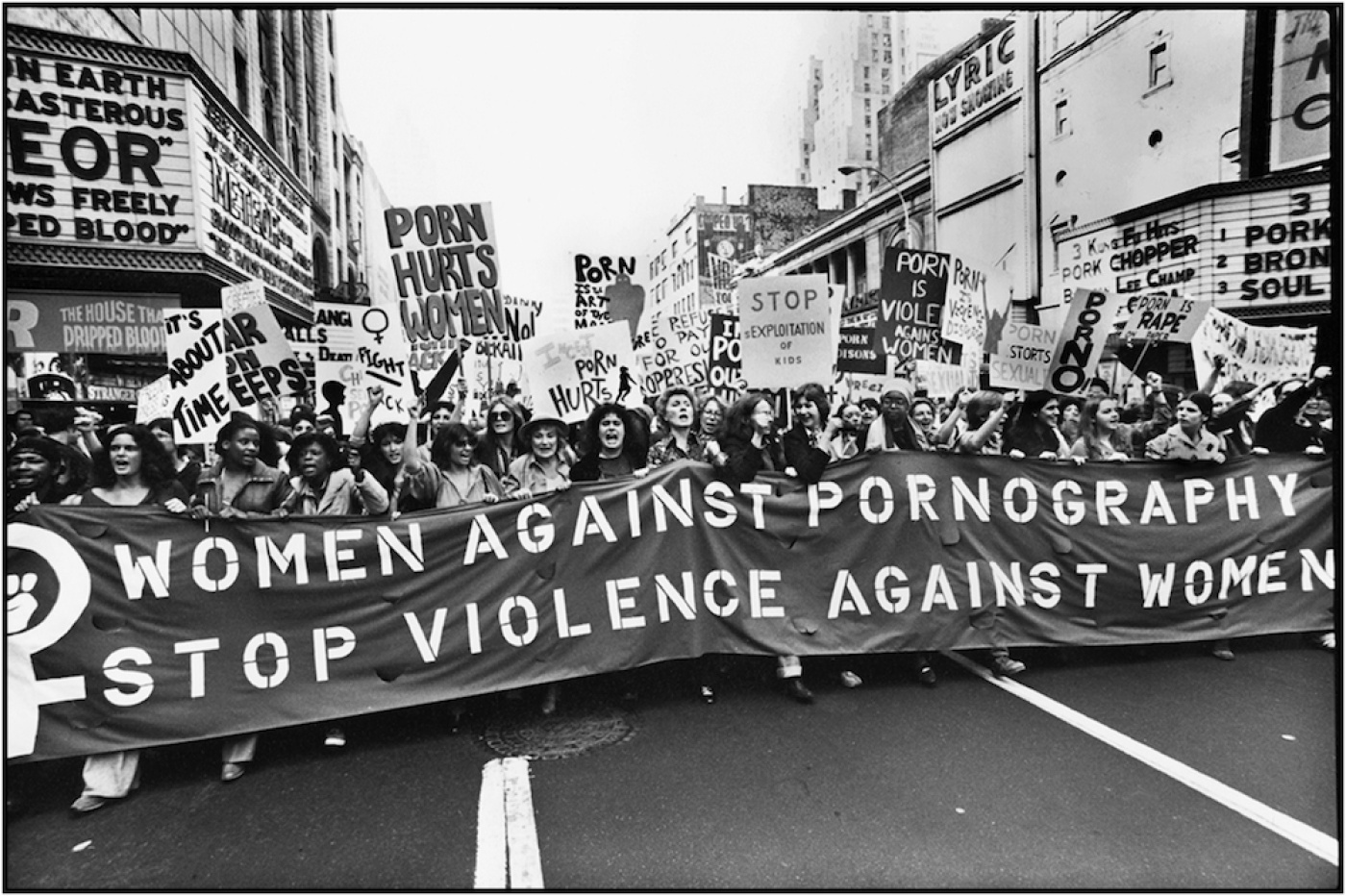
The first protests of second-wave feminism emerged in the late 1960s, partly in response to misogyny within left-wing movements themselves. From the mid-1970s onwards, the women’s movement increasingly shifted its focus towards pornography, which was seen as a key mechanism in the oppression of women under patriarchy.
In 1976, the first explicitly anti-pornography activist group was founded in San Francisco: Women Against Violence in Pornography and Media (WAVPM). The organisation opposed, among other things, peep shows, BDSM practices and depictions of sexual violence against women. In 1978, it organised the first national anti-pornography conference and a protest march, at which Andrea Dworkin also gave a speech. A few years earlier, she had already protested against a screening of the violent film Snuff at a New York cinema.
The movement subsequently continued in New York under the name Women Against Porn (WAP), which organised, among other activities, tours of sex shops and strip clubs to raise awareness. Its premise was that pornography was not merely a misogynistic representation of women and sexuality, but also functioned as patriarchal propaganda legitimising violence, including sexual violence. Pornography was therefore seen not only as a reflection of reality, but also as a force actively shaping that reality.
A major turning point came in 1980 with the publication of Linda Lovelace’s (born Boreman) memoirs, in which she testified about the abuse and violence she said she experienced during the production of the successful pornographic film Deep Throat (1972). She publicly shared these revelations at the book’s press conference, accompanied by Andrea Dworkin and Catharine MacKinnon.
This prompted Dworkin and MacKinnon to develop the Antipornography Civil Rights Ordinance, a proposed law defining pornography as a violation of women’s civil rights. It would have enabled women who had suffered harm through pornography — whether as performers or indirectly — to take legal action against producers and distributors. Although the proposal gained traction in several states, it was ultimately not adopted, as pornography was deemed to fall under the protection of freedom of speech.
At the same time, critical voices emerged in opposition to what they saw as the sexual puritanism and authoritarian moralism of anti-pornography feminists, which they believed posed a threat to women’s freedom. In response to organisations such as WAVPM, Samois, a collective of women from the BDSM community, was founded in San Francisco in 1978.
In 1981, feminist Ellen Willis published her influential essay Lust Horizons: Is the Women’s Movement Pro-Sex?, in which she introduced the term “pro-sex feminism”. This movement emphasised the importance of sexual pleasure and autonomy for women and opposed what its proponents described as reactionary tendencies within anti-pornography feminism, which they believed aligned with conservative right-wing ideologies. From this perspective, sexual freedom was essential: women should have the right to have sex whenever, however and with whomever they wanted, without stigma or shame.
Tensions between the two camps reached a peak in 1982 during the Barnard Sex Conference, organised by, among others, Ellen Willis, Gayle Rubin and Carole Vance. The conference centred on the importance of non-reproductive sexuality and was surrounded by controversy even before it began. WAP members, including Dworkin, flooded Barnard College with angry letters and phone calls. Under this pressure, the college confiscated thousands of copies of the Diary of a Conference on Sexuality the day before the event, fearing the loss of funding.
Although the conference ultimately went ahead, it was accompanied by protests from WAP members, and the conflict developed into a widely publicised debate. In 1984, controversy surrounding censorship, including in response to Dworkin and MacKinnon’s Antipornography Civil Rights Ordinance, led to the establishment of the Feminist Anti-Censorship Taskforce (FACT).
Pro-sex feminists also campaigned for sex workers’ rights and emphasised the importance of free choice within the profession. Yet both camps often remained blind to the complex realities of marginalised groups, among whom sex work is most prevalent. Anti-prostitution legislation disproportionately affected Black, economically vulnerable and LGBTQI sex workers, while in practice legalisation more often benefited a white, highly educated class.
Nona Demey Gallagher & Dina Dooreman