Who seeks, who finds

Mimi's Shebeen


EVENING PROGRAMME


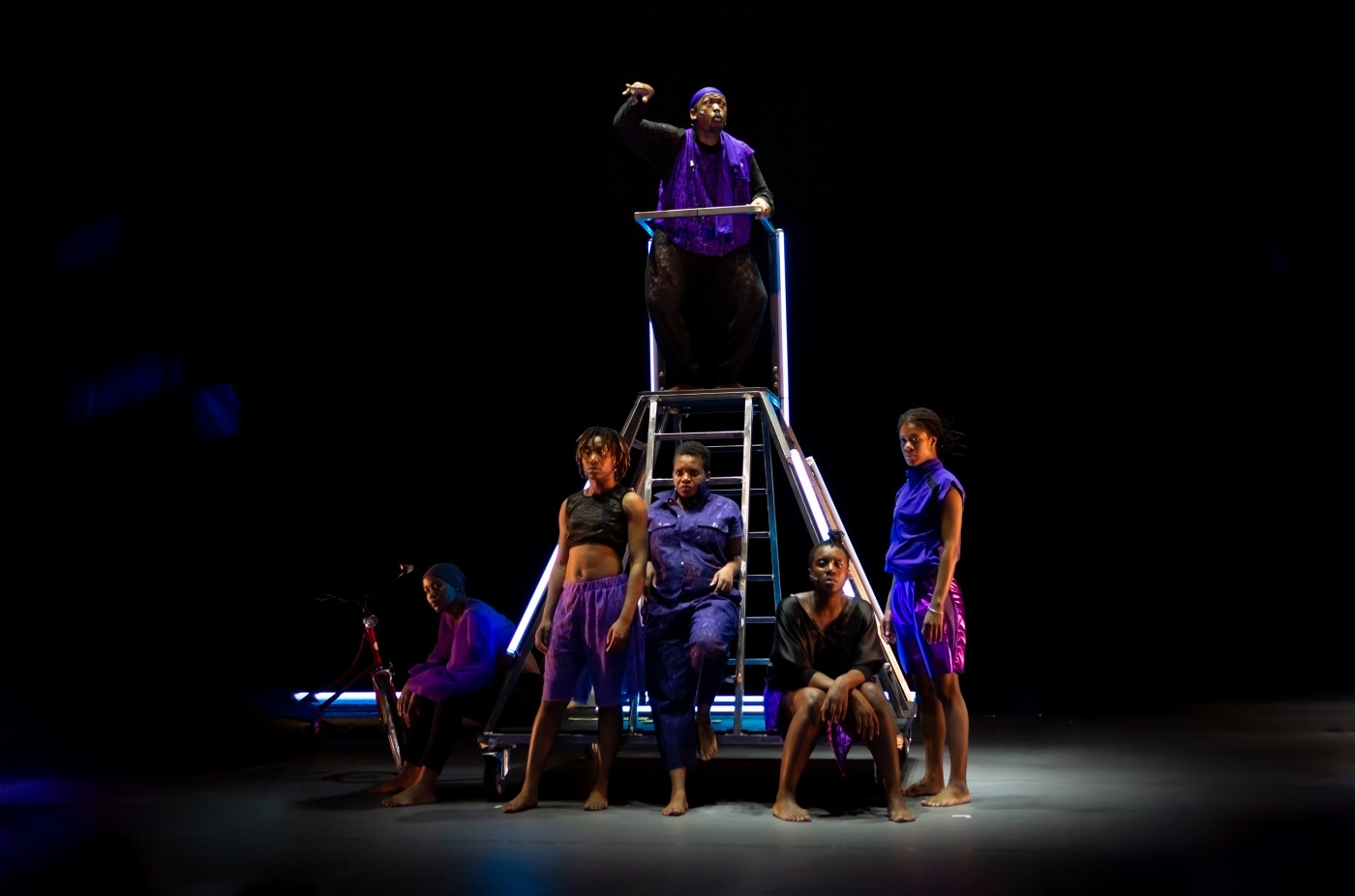
Mimi’s Shebeen is a new poetic dance theatre production by KVS face and artist Alesandra Seutin. Through dance, poetry, singing and music, Seutin takes the audience into the depths of a deconstructed shebeen and on a journey full of life: of struggle, perseverance and determination.
 

This is a Mimi Shebeen
our house is her house
we come here, we rejoice and we cry
this is a Mimi Shebeen
people take their places with them
women do not need to be saved
if she ain’t your sister
she must be your aunt
this is a Mimi Shebeen
we dance, we discuss, we lay our lives down here
they can turn everything upside down
but not our smile
this is a Mimi Shebeen
everything is purple here
a life lived on the tips of our tongues
a promise, a picture.
 

Starting with the exile of South African singer Miriam Makeba from her own country, Seutin uses Makeba’s legacy as a political activist to convey stories of exile, immigration and humanity.

Mimi’s Shebeen will infuse the unique and unmistakable signature style of Seutin’s hybrid Dance Theatre. Lebo Mashile and Lisette Ma Neza provide the text, Angelo Moustapha and Zouratié Koné the music, and Tutu Puoane sings. 


© Danny Willems

Background information

What is a shebeen?

The apartheid regime forbade black South African people from drinking or talking about politics; they had to work above all else. In order to still be able to get together and relax, activists sought out underground huts and bars, complete with boys on the lookout and storerooms for supplies. There they brewed Umqombothi, or corn beer. If the police discovered a shebeen, they immediately closed it down and arrested anyone involved. Most shebeens are run by women, known as shebeen “queens”.

Who is Miriam Makeba? 

Zenzile Miriam Makeba (4 March 1932 – 9 November 2008), nicknamed Mama Africa, was a South African singer, songwriter, actress, and civil rights activist. She had a life of remarkable global impact. She contributed to Black people’s struggle for liberation and defended the integrity of African identity and artistry while living in a land absent of her ancestry.

Baby in jail

Miriam’s mother was an activist, a traditional healer (aka Sangoma) and she owned her own shebeen. Two weeks after Miriam Makeba was born, she was arrested and jailed for illegally selling beers like Umqombothi in equally illegal shebeens. As a result, Makeba spent the first months of her life in jail.

30 years in exile

When Makeba wanted to return to South Africa in 1960 for her mother’s funeral, the South African government denied her entry, after which she lived in exile for 30 years. Later, her citizenship was also revoked. After her banishment Makeba went to live in America. Her political activism brought her to testify before the United Nations in 1963, after which her records were banned in South Africa. In the late 60s she became ostracized in the US and she took refuge in Guinea, where she lived until 1985 before moving to Brussels. In 1990, after 30 years in exile, she returned to her native South Africa at Nelson Mandela’s invitation. She died in Italy in 2008.

World hit

Miriam Makeba was one of the first to introduce African music to a Western audience. Her biggest hit was the song Pata Pata (1967). With her fame, she prepared the way for other African artists such as Youssou N’Dour and Fela Kuti. Makeba successfully toured Europe and the United States, and in 1987 she joined Paul Simon’s Graceland tour.


INTERVIEW WITH

Alesandra Seutin

Rokia Bamba talks to Alesandra Seutin about her new dance theatre piece Mimi's Shebeen. Multi-talented Rokia Bamba is a DJ, radio presenter, sound explorer & artiviste. She is an enthusiastic positive voice in the Brussels scene, omnipresent in various subcultures and on ditto stages, from RTBF to StuBru, from Paris to Frankfurt.


© Danny Willems

Trailer


The Cast


Alesandra Seutin

Alesandra Seutin is an award-winning multidisciplinary performance artist and creator, whose focus is exploring movement as a foundation for theatre, media and site-specific works. The daughter of South African and Belgian parents, Alesandra was born in Harare, Zimbabwe. She calls herself an ‘Afropean’. An inspirational leader with a multifaceted career spanning two decades, she has reached global audiences through her work as an artistic director, choreographer, performer, mentor, teacher, movement director, dramaturg and writer for performance and music.  

Alesandra completed her training at Trinity Laban Conservatoire of Music & Dance and Middlesex University in London. She works internationally, mainly dividing her time between Senegal, Belgium and the UK. The world is her muse and through her creations she comments on social, political, and economic reality with dance, song, and music. The notion of “getting or taking a place” is central to Seutin’s work, as is finding your place in major cultural institutions: the spaces that are not obviously ‘yours’. 

She founded her company Vocab Dance in 2007 and has steadily built its reputation for creating high-quality, artistic performance. Renowned for their distinctively theatrical choreography and blend of movement vocabulary, text and dance, the company’s work is focused on the exploration of subjects which impact our society, and with this capture their audience in a journey of compelling and outspoken dance theatre. Vocab Dance’s repertoire is diverse with over eleven productions in its catalogue, ranging from solos to ensemble pieces for indoor stages and outdoor settings.   

Alesandra Seutin’s work has toured across the UK, Europe and internationally, and she has received over 20 choreographic commissions including Sadler’s Wells, KVS, Merce Cunningham Company, Wellcome Collection, Channel 4, Phoenix Dance Theatre and National Youth Dance Company.  

Seutin also continues to perform and has recently returned to the stage in Dear Winnie, an award-winning, multi-disciplinary performance work about the life of Winnie Mandela for which she was also the choreographer and movement director. 

Alongside her work with Vocab Dance, Seutin was announced as the Co-Artistic Director of the famed École des Sables in Senegal in 2020. Having trained at the institution herself under Germaine Acogny, Seutin is a worldwide ambassador and teacher of the Germaine Acogny technique. In collaboration, they both direct the development of the internationally renowned training programme and professional performance company, Company Jant-Bi | Germaine Acogny. She was also guest director for the UK’s National Youth Dance Company from 2019-2022. 

In addition to her work on and off stage in performance and writing, Alesandra Seutin spends much of her time mentoring and developing the careers of future generations of makers and creatives. 


Kopano Maroga

Kopano is a South African performance artist, writer, cultural worker, and co-founder of the socio-cultural arts organisation ANY BODYZINE. Kopano lives in Brussels and is a curator and dramaturge at the Arts Centre Viernulvier in Ghent. 

Their academic background is in dance and social anthropology (BSocSci) and theatre and performance (MA). They have worked as a dancer with choreographers Kristina Johnstone, Nicola Elliot, Celeste Botha, Alan Parker, Jan Wallyn and Underground Dance Theatre. They are a recipient of the Kanna, kykNet Fiesta and Woordtrofees for best supporting actor for their performance in Neil Coppen’s Buiteland/Newfoundland. 

Additionally, they actively work as a dramaturge, providing dramaturgy for artists Joshua Serafin, Jan Wallyn, Moya Michael, Khadija El Kharraz Alamu, Carolina Maciel de França, Alesandra Seutin and others.

Their present interests lie at the intersection of art, social justice, and healing knowledge systems. Their current research is in the potential of disidentification and biomythography as tools for destabilizing rigid identity theory. They very much believe in the power of love as a weapon of mass construction.


Nandi Bhebhe

Nandi Bhebhe is a British born, Southern African actor, dance artist and maker, and trained at the Liverpool institute of Performing Arts. As a multidisciplinary artist, Nandi has worked across the UK, and internationally spanning stage and screen.

Nandi’s range of works include A Season in the Congo at The Young Vic directed by Joe Wright and Sidi Larbi Cherkaoui, Bill T. Jones Fela! at the National Theatre and on Broadway, Wrath for Channel 4s Random Acts, two seasons at London’s Shakespeare’s Globe Theatre. Productions of 946, The Tin Drum and UBU with renowned devised theatre company Kneehigh Theatre, A Monster Calls at The Old Vic Theatre, and most recently Wise Children’s Wuthering Heights at St Annes Warehouse, New York.

Nandi also co-directs work with artist Phoebe Davies as Bhebhe&Davies. Their work includes Creases, commissioned for the Tate Modern, and most recentlyViscera, a short film produced with the Wellcome Collection. Viscera was awarded Best Dance Film in the Aesthetica Film Festival 2022. 

Nandi has had the pleasure of working with Alesandra Seutin || Vocab Dance Company since 2009 on productions including Kwenda-Kwenda, So.We.To, Episodes of Blackness and Boy Breaking Glass, and is very thankful and delighted to be joining the company for its premier of Mimi’s Shebeen at KVS. 


Nosiphiwo Samente

Nosiphiwo is a dancer, dance teacher, facilitator and choreographer born in South Africa (Cape Town) who graduated with a Bachelor of Arts (BA) from the University of South Africa. A passionate and creative person, she is associated with the dance company ‘Forgotten Angle Theatre Collaborative’ and has performed in various theatre productions, from physical theatre, dance theatre works to plays such as Indumba; Cargo: Precious. Nosiphiwo also did a production called Where is Home with State of Emergency based in England and have been touring with the production for 2 years. Recently, the artist performed the piece DOLL at the Dance Umbrella festival. 

Nosiphiwo also got the chance to collaborate with Alesandra Seutin and Melissa Eveleigh on workshops and creative processes. Currently, she is even taking part on Seutin’s Boy Breaking Glass performance. On the production of Black Victorians, she also worked together with Jeanefer Jean-Charles. 

She is also known as an actress through a supporting role in a television series and as a judge on the dance programme Jika Majika on SABC 1. Moreover, she was also one of the top 16 finalists in So You Think You Can Dance Season 3 (SA).


Tutu Puoane

Tutu Puoane is an internationally renowned (jazz) singer who grew up in the townships of Pretoria in South Africa. She studied at the Music College of the University of Cape Town (UTC) before moving to Europe. Tutu spent two years at the Royal Conservatoire in The Hague (Netherlands) and eventually moved to Antwerp. 

Tutu’s music is a mix of African, European, and American traditions. Her repertoire includes her own compositions, songs from the Great American Songbook and arrangements of South African originals. Tutu performed with Toots Thielemans and Brussels Jazz Orchestra, among others, and made several solo CDs. Two of her albums, Quiet Now and Mama Africa (a collaboration with Brussels Jazz Orchestra) were awarded a South African Music Award (SAMA) for Best Jazz Album in 2010 and 2011. Breathe was the first release from SoulFactory Records, the independent record label she founded with her husband, music, and business partner Ewout Pierreux.

Besides music, Tutu is also increasingly involved in theatre. In 2015, she worked and toured the world with Wim Vandekeybus and his dance theatre production Speak Low If You Speak Love by Ultima Vez. Since 2019, she has been one of the actresses in an all-star cast of Dear Winnie, the highly successful and award-winning co-production of KVS (Brussels) and NNT (Groningen). In the coming years, Tutu will lend her collaboration to several (music) theatre productions by KVS. 


Zouratié Koné 

Zouratié Koné is a master percussionist, descendant of a family of Griots (traditional healing artists) who was born in Bobo Dioulasso (Burkina Faso) and lived in Mali and Ivory Coast. Singer, musician, and maker of traditional musical instruments, he is recognised as a Master on the djembe, the dumdum, the tama (talking drum), the longa, the kora, the ngoni and the balafon. 

Since 2013 he has been travelling between Belgium and Burkina Faso, to participate in the Belgian Afro-Jazz sextet musical project, Afrikan Protokol. From 2018, he has been leading his own musical project of Afro Jazz Mandingo, based in Brussels, the ‘ZKE!’ (Zouratié Koné Ensemble). One year later, he played in the Moonlight Tales project and preformed regularly with the Belgian songwriter and musician Sébastien Haciane for the project Besac Arthur. He also started a musical project mixing electronic and Mandingo music, the Electro Mandingo Groove. In July 2020 their first song Sogni was released by the label Orianna / Sony Music.  Zouratié continues exploring the Mandingo musical tradition. In 2021 he co-founded, the project Diurukuma Beat.

Since 2017 he has been artistic co-director, together with Ombretta Moschella, of the non-profit organisation Amu Les Griots based in Belgium. In 2021 they founded the label Electro Mandingo Records - Making music travels beyond borders. 


Angelo Moustapha

Angelo Moustapha, born in Benin, is a drummer, percussionist, composer, and arranger. At 7 years old he was already giving his first concert. More than a passion, music is a vocation for this multi-instrumentalist whose influences include traditional music, modern music, and jazz. His talent was consecrated in 2017 when he was nominated for a MIA and became the best drummer in Africa at the Festival of the Best Instrumentalists of Africa.

Angelo obtained his Professional Diploma of Potential, Competence, and Intrinsic Capacity in 2017 at the Ecole Supérieur des Métiers d’Art et de la Culture (ESMAC HWENDO Benin). 

Troubadour of drums, Angelo Moustapha is a manifestation of percussion rhythms in all its plurality. In addition to his personal projects (Solo, Duo with Sylvain Debaisieux, Ibiyewa ...)  Angelo Moustapha composes and participates in the realization of several projects of artists in various fields. Notably on the album Elephant de Mu and his show C’est quoi l’afrique? at the Senghor in Brussels, the trio project with Lionel Loueke and Philip Catherine at Flagey. The two Piano’s project with Philip Catherine, Bert Van Den Brink and Nicola Andrioli and “Aro Ilè” a performance by Awoulath Alougbin.


Rose Aida Sall Sao

Rose Aida Sall Sao is a Dutch/Senegalese independent dance artist, choreographer and dance educator based in London. She graduated from Fontys Dance Academy and Northern School of Contemporary Dance in 2017 where she had the opportunity to perform in works by Joan Cleville, Tony Adigun, Jens van Daele, Guy Shomroni & Yaniv Abraham. She is a JV2 Professional Diploma graduate and toured in the UK performing works by Jasmin Vardimon, Yunkyung Song and André Rebelo. Over the years Rose has worked for C12 Dance Theatre, Chhaya Collective, Heatherwalrond Company, Isabella Soupart, Tribe //, Tom Dale Company, Fubunation, Seke Chimutengwende amongst others. 

She is currently working as a dancer with Botis Seva / Far From The Norm and Alesandra Seutin (Vocab Dance). She also creates her own work and is co-founder of Nomad Dance Collective.


Kenza Deba

Kenza has been practicing krump since she was four years old. She puts her dance skills on display in battles and shows as a member of the Drickx fam. The first creation she dances in is SPEAK, a choreography by Hendickx Ntela. You can also see her in action in Angles Morts besides Joëlle Sambi and Sara Machine. She is an active member of the Belgian krump scene and organises the event How to fix your krump, in which older and younger generations share knowledge through workshops taught by international krumpers.


© Danny Willems