


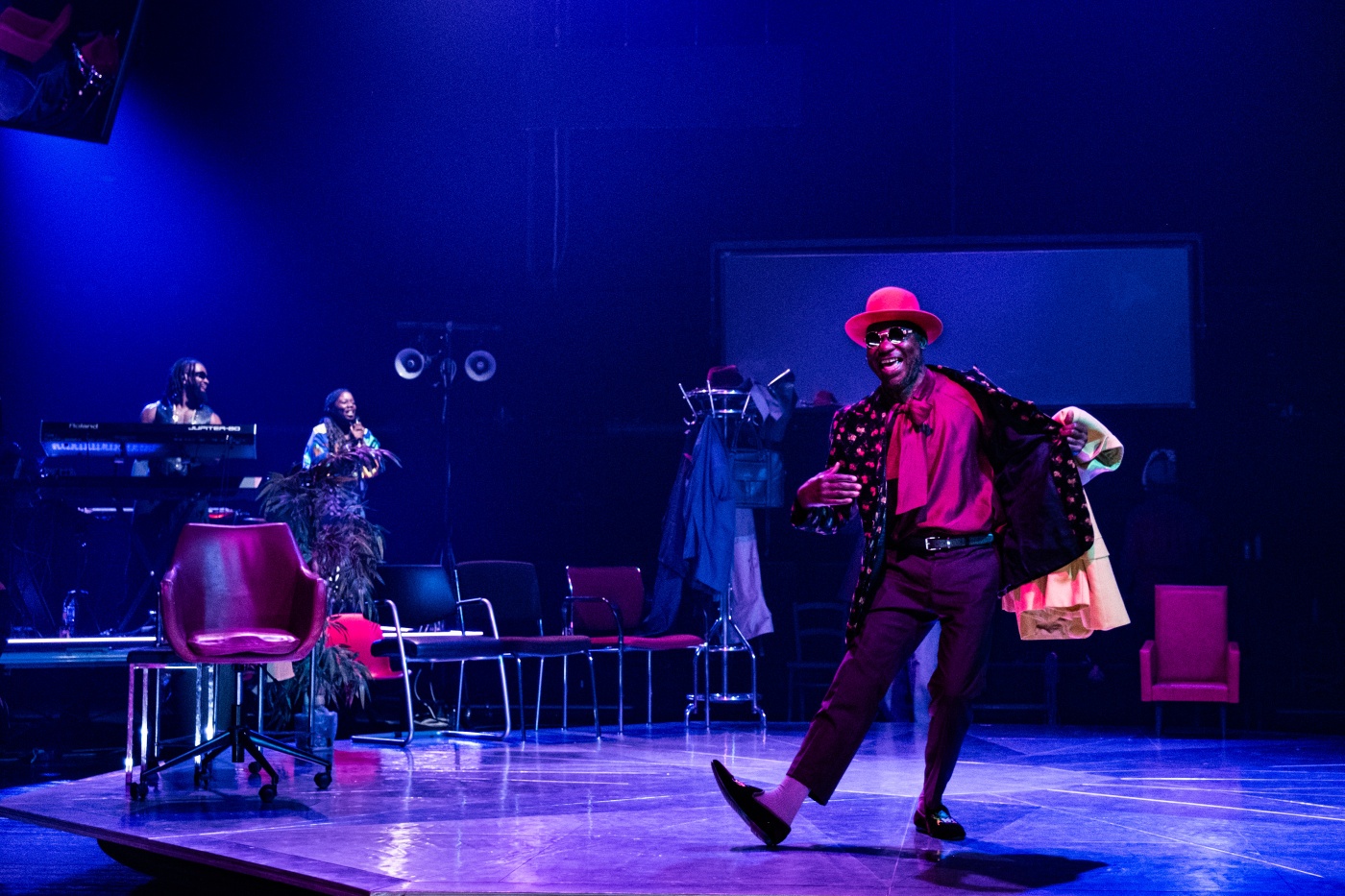
The premiere of the French version of Barber Shop Chronicles was met with a standing ovation on September 21 at Théâtre de Liège. The original play by Inua Ellams had already enjoyed great success in the United Kingdom before embarking on an international tour across the United States, Canada, Australia, and New Zealand.
Serge Rangoni, artistic director of Théâtre de Liège, recognized the tremendous potential of the work and initiated a collaboration with KVS, under the direction of Junior Mthombeni and Michael De Cock. One of the central questions quickly arose: since the play is set mainly in England, South Africa, and Ghana, should the team stay faithful to those original narratives? Or should the work be adapted for the European continent and for French-speaking African communities, grounding it more deeply in the Liège and Brussels contexts?
Together with author Inua Ellams, the creators chose the latter path. Following an initial translation by master’s students in translation at the University of Liège under the supervision of Valérie Bada, Barber Shop Chronicles was “tailored” into French. The “tailors” in question: Caroline Gonce, project manager and coordinator of the actors’ repertoire at Théâtre de Liège; Senegalese historian and multidisciplinary thinker Omar Ba; and actor, musician, and creator Junior Akwety, all working closely with the directors. Dramaturg Gerardo Salinas spoke with Omar Ba and Junior Akwety about their creative process.
How did you choose which countries to include?
Junior:
“The selection of countries stemmed from Inua’s original text. We tried to capture the subtleties he wanted to highlight and to identify francophone countries where similar stories or themes could be found. Some countries quickly stood out more clearly than others.
Current events also played a role: when Inua wrote the play, he drew heavily from what was happening in the world at that moment. We focused on what was making headlines in francophone African media, in our own countries, and integrated those elements into the rhythm of the text.”
“What helps is that, across Africa, despite national and cultural differences, there’s a remarkably similar social dynamic. Many themes resonate equally in anglophone and francophone countries. That made the project feasible from the start: we could create a francophone version by adapting the contexts, countries, characters, references, and ethnic backgrounds. It opened up so many possibilities.”
Omar:
“Exactly. In the original text, the choice of countries was based on the opportunities they offered. Inua also considered demographic representation and relevance for a British audience. For the francophone version, we carefully selected comparable countries: Burkina Faso – with its current political turbulence, its charismatic military leader, and its debates on neocolonialism and the legacy of Thomas Sankara; the Democratic Republic of Congo, because of its ties to Belgium, its colonial past, and its well-established diaspora; and Côte d’Ivoire and Senegal, both with strong symbolic capital, large diasporas in France, and historical parallels with the anglophone countries in the original text.”
How did you approach linguistic nuances and humor?
Junior:
“Linguistic nuances and humor are central to African societies. Laughter, teasing, and banter are part of everyday life – it’s a living, ever-present energy. So, it wasn’t difficult to bring that into the French version.
As for linguistic nuances, we wanted to understand the particular dynamics of each country. In Cameroon, for example, there’s ‘Frenglish’– a blend of French and English that’s naturally evolved from bilingualism. It was important to preserve that.
We also placed a lot of trust in the actors to develop this dimension. They know their cultures better than anyone, and they bring a broad understanding of context. We relied on them to question and refine the language, simplifying certain elements for fluidity. That helped us strike a beautiful balance – onstage and in the text.
We even slipped in a little gem from Haiti. We built a solid foundation for the actors to build upon, since they ultimately carry the piece. For each character, the language had to flow naturally.”
Omar:
“Despite the diversity, there’s no real distance between the countries. Each has its humor and linguistic quirks, but the underlying tone is often the same. The African diaspora shares many cultural codes through music and the internet. French is a rich language that adapts beautifully to cultural contexts, allowing nuances to shine through word choice, tone, and accent.
At the same time, the differences from the original text are clear: history, colonial experience, and local contexts add distinctive inflections, yet there’s also a sense of shared cultural affinity.”
What about local accents and political context?
Junior:
“Inua’s original text already referenced political and historical events to illuminate certain themes and reflect social processes. Politics is part of daily life for Africans – it’s tied to the pursuit of a better present and future. We therefore had to address it – with humor, seriousness, and respect.
At the same time, we were able to retain elements of the original while adapting to local contexts, which differ greatly from one another. Africa consists of thousands of peoples, numerous languages, and immense cultural wealth. When it came to accents, we let the text shape the character, and then the character became the foundation for a voice, an accent, and a story. From that, we built what felt most natural in each country – while preserving the subtle poetry of Inua’s writing, its musicality and precision.
The goal was to create natural, conversational dynamics that evoke cities like Yaoundé, Kinshasa, Abidjan, or Dakar, but also the African diaspora in Brussels. It was about finding common ground and developing a meaningful, continent-wide theme. The process unfolded through compromise and dialogue with Inua – which was deeply enriching.”
Omar:
“Politics and social context aren’t just the backdrop – they’re integral to the stories and the play’s energy. They shape living conditions and determine how people fight to survive every day. For many, that’s also what drives migration.”
How does the play reflect the diversity of diasporas and countries?
Junior:
“The diversity of the African diaspora is fully visible in the barbershops of Matonge in Brussels, where Senegalese, Ivorians, Cameroonians, Congolese, and Burkinabé meet. That diversity is clearly reflected through the cast itself, each actor bringing a different background.
Even within the represented countries, the characters are portrayed in diverse ways. There’s a range of techniques and performance styles that express each country’s unique dynamic. As in any society, people differ – but together, they create a shared urban culture.”
Omar:
“That’s true – the barbershops are like miniature islands of the African continent. People of different nationalities meet or work together there, making the continent’s cultural and national diversity visible.”
How were the actors selected and involved?
Junior:
“The artistic team – directors Junior Mthombeni and Michael De Cock – handled the casting. I had the chance to meet all the actors; most had gone through auditions, and their desire to be part of this story really moved me.
They were involved from the very beginning of the creative process. During the first reading, we asked them about the credibility of the characters and their stories. The actors did in-depth research on accents and language use, and they actively helped shape their characters. It was a highly collaborative process, marked by constant dialogue between dramaturgy, stage design, and direction.”
How did you establish the tone and energy of the play?
Junior:
“The tone and energy were strongly influenced by the generosity of the ensemble. There was a genuine desire to share emotions and build brotherhood. The play carries that essence – taking care of the story so that it resonates and has impact.”
Omar:
“The tone and energy emerged during the writing process itself. Each character was given a voice, a color, and a depth that made the dramaturgical and directorial work flow naturally. The final result remains true to the energy of the original while embracing a new context with its own unique signature: explosive, profound, and light all at once – a mosaic of feelings.”
Interview by Gerardo Salinas, Dramaturg at KVS