


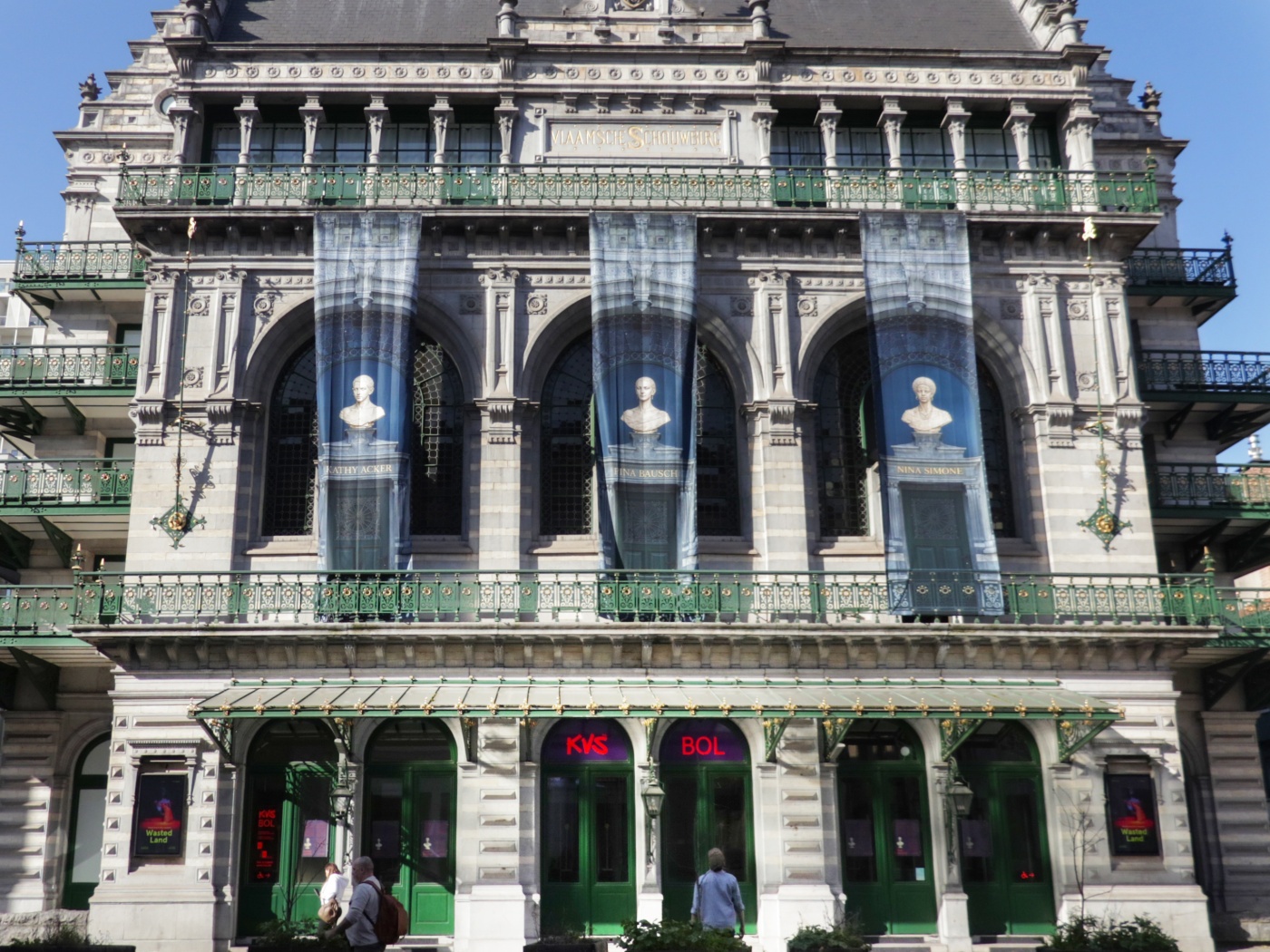
For 140 years, the busts of three men have adorned our theatre façade (Pieter Langendyck, Joost van den Vondel and Willem Ogier). On the occasion of International Women’s Day on March 8, we asked three KVS faces which woman they would like to see shining on our building. The answers were Pina Bausch, Nina Simone and Kathy Acker — but choosing was anything but easy.
Moya michael chooses nina simone
Choreographer Moya Michael, who will be unveiling a new creation next season, opts for the High Priestess of Soul: Nina Simone.
One thing is certain: when I think of iconic female artists, it has to be a Black woman! There are so many brilliant Black female artists, but Nina Simone and Toni Morrison helped shape my world when I was a child. Nina’s songs blasted on repeat through the speakers, and Toni’s books kept me awake at night.
If I really have to choose, it’s Nina. A bust for her in Brussels — a Black woman, so central and visible — would be groundbreaking in a city that is still shaking off its colonial ghosts. Both Nina’s and Toni’s activism has touched so many people so deeply, but Nina’s raw voice that hits you right to the core moves me the most.
carme portaceli chooses pina bausch
Spanish director Carme Portaceli created the production Maria Magdalena, part of a series of performances centred on iconic women (Mrs Dalloway, Emma Bovary, Jane Eyre, …). Her choice for the bust is the legendary choreographer Pina Bausch.
I fully support this initiative. When I was head of Teatro Español, I undertook a similar action and gave female authors a place on the ‘wall of fame’, which had consisted exclusively of men. As good and important as those men may be, there are so many female authors, artists and directors who have long been shamefully overlooked. I’ve been fighting this my whole life, on and off stage. So choosing just one was difficult.
Maria Magdalena, whom we’ve just made a play about, was of course an option. She was terribly misrepresented in history — come see the play to understand how. Marguerite Yourcenar was also high on my list: a wonderful Belgian-French writer. A committed feminist and humanist.
But if I have to choose, I go with Pina Bausch: such an extraordinary artist who forever changed theatre, dance, and the way we look at them. A theatre-maker through and through.
nona demey gallagher chooses kathy acker
Nona Demey Gallagher recently directed Copyriot, will present several productions at KVS in ’26–’27, and agrees with Carme and Moya: to choose is to lose. But since she must, she gives the statue to Kathy Acker, of whom she’ll adapt the novel Don Quixote: which was a dream for the stage in 2027.
Kathy Acker’s work stands out to me because it is at once crude, intellectual, pornographic and theoretical. It’s funny and aggressive, politically incorrect, and at the same time says so much about the world we live in. More people should read her work!
Other women on my shortlist included Artemisia Gentileschi, who fought an older but no less radical battle. As a female painter and key figure of Baroque art in the 17th century, she worked within an art canon that systematically excluded women. In her work, women are not passive objects but active, violent subjects. Her story is also fascinating in terms of authorship: for a long time her work was wrongly attributed to her father, because people didn’t believe a woman could create such powerful pieces.
Lastly, Pamela Anderson is, for me, a cultural pop icon in terms of sexuality and desire. For years she was reduced to a sex symbol in a male-dominated industry. At the same time, she consciously used that image and later reclaimed it herself.