


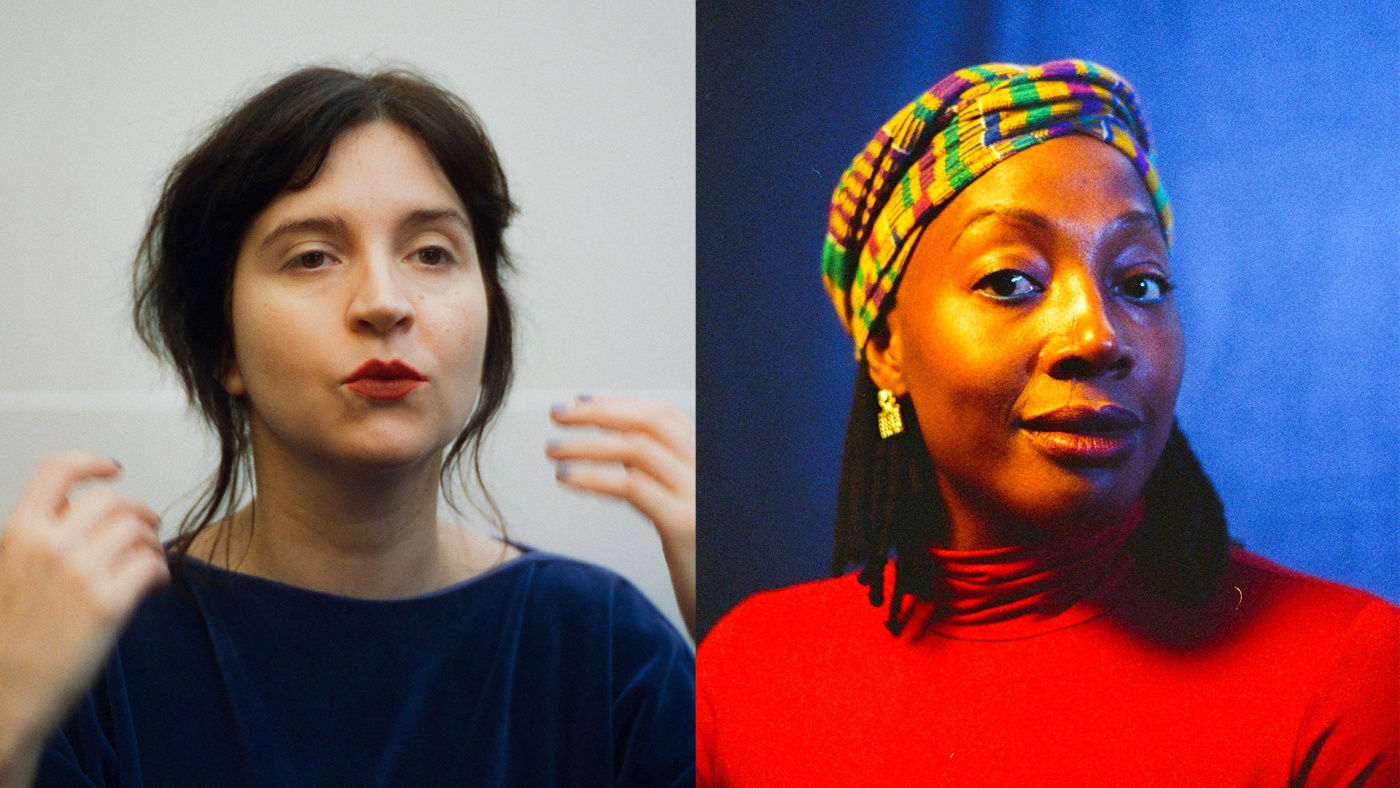
2026 will be an exciting year for KVS faces Alesandra Seutin and Carolina Bianchi. Both creators are coming face to face with their previous work in Brussels. Bianchi completes her Cadela Força trilogy with a performance that addresses the destructive nature of writing, while Seutin adds a second act to her creation Ceci n’est pas Noire from 2013.
Carolina Bianchi is a writer, theatre director and performer. In her own words, her life and her creative process are “a constant negotiation between what it means to create work that addresses trauma, language, sexuality, and art history – unruly work that is sometimes very violent and difficult – and yet, to also find a lot of tenderness within that process”. She is the director of artist collective Cara de Cavalo, with whom she had been working for over ten years, including for the Cadela Força trilogy. After processing the cruelty of sexual violence in The Bride and the Goodnight Cinderella, Bianchi explored brotherly bonds and their complex entanglement with theatre history in The Brotherhood. In the third chapter, which premieres in 2026, Bianchi wants to investigate the brooding nature of writing; what it means to type away in silence; what poetry can be found in violence; the clash of alter egos and the slumbering destructive, chaotic powers of textual creation.
Alesandra Seutin is a choreographer, performer and director. Her explicit multidisciplinary approach interweaves movement, text and music to investigate topics like identity, memory, and the politics of the body. In 2013 she created Ceci n’est pas Noire in London. Until then, she had mainly created very physical performances with large ensembles. Ceci n’est pas Noire was much more intimate, a multidisciplinary solo about her own identity – daughter of a Black South African mother and a white Belgian father, born in Zimbabwe, raised in Brussels before moving to London, mother, creator, friend. In November of 2026, Seutin presents Ceci n’est pas Noire: Act II at KVS. More than ten years post-date, she reflects back on the questions she posed at the time.
Both of you are returning to earlier work. What did that teach you about those performances?
Carolina: The Cadela Força trilogy started nearly eight years ago – a long time. I still lived in Brazil when I started my investigation. Since then, both the COVID pandemic and me moving to Europe have left significant marks on the creative process. For me, this year feels like the closing chapter of a major period in my life – major in terms of time, and its passing.
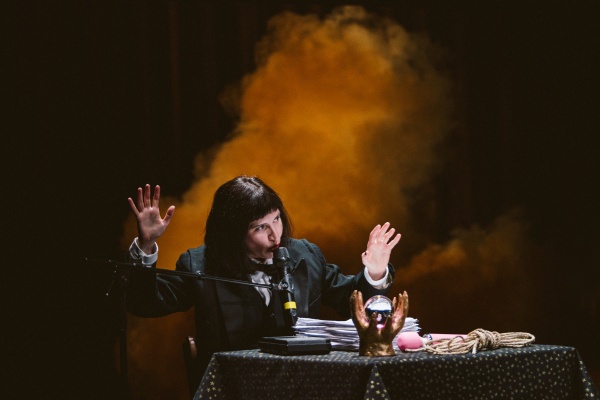
Over the years, I have changed so much that now – as I write the third part – I can almost physically feel the previous two chapters watching over my shoulder. At the same time, I want to liberate myself from those works in order to freely reinvent how I speak to the audience, and to develop a specific language for this new work – something I also tried to do in the previous parts.
I am looking for ways to remain uninhibited and experimental, and to create conditions where something can be studied to its core. I think this quest is at the root of the trilogy, and it explains the time between the chapters, as well as the ways in which the various parts mirror or clash with each other. This third chapter requires me to remain process-oriented and open, and to move through deeper shadows.
Alesandra, is that recognisable for you?
Alesandra: Yes, absolutely. The realisation that you’ve changed, which begs the question – does this work still relate to who I am today? For me, that is also strongly connected to changing geography. When I made Ceci n’est pas Noire, I lived in the UK and I was primarily speaking to my local audience there: a British audience of mixed backgrounds, Caribbeans, people who are displaced. The creation was strongly connected to those surroundings. Back then, I mostly spoke to people who constantly questioned my identity.
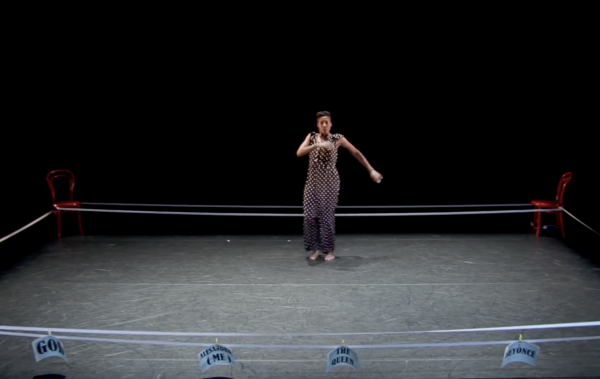
Now, I want to find new answers here – not just for them, but for others, too. The work is being created in a completely different context. I am thirteen years older. I live in Belgium. My body has changed. I have travelled, lived elsewhere, had a different life. This time, I am no longer asking my questions to an external audience, but to my white father.
The title of your creation refers to Magritte’s Ceci n’est pas une pipe and his surrealist legacy, often associated with Belgium. Suzanne Césaire called surrealism “the tightrope walk of hope […] amidst the mighty war machines the modern world offers us”. Does that resonate?
Alesandra: Yes, I think so. For Césaire – and for many people of colour – it’s a survival mechanism. When the material reality is hard, the battle is tense, and the body endures so much trauma, surrealism offers space to imagine, to dream, and to open up a world in which you would want to live or exist. It’s a way to briefly escape the reality of certain systems that are in place and that make everything rigid and stuck. In a way that’s what we, theatre creators, do. The theatre is a surrealistic concept: sitting in a room together and allowing the audience to move to other worlds, to be transported. So yes, absolutely. Ceci n’est pas Noire also bathes in that. Not everything is logical, not everything fits neatly.
Carolina, your beloved writer Clarice Lispector writes: “My unbalanced words are the wealth of my silence.” How does that resonate for you?
Carolina: To be honest: in my recent work, and especially this latest one, silence is not very present for me. Not that it’s fully absent, but it’s not what I seek out or where I want to go. This is also because the work centres on trauma, connected to sexual violence and to art history – which itself is rife with (sexual) violence. In that framework, silence often appears as a no: being unable to speak, unable to verbalise the damage being done.
For that reason, I think I prefer to say that I am increasingly focusing on a voice that is broken. On what such a voice can do, what it can carry, what it can sing – especially in this latest work, where we use a lot of singing. It’s not a voice of victimhood, but a voice with a different quality: broken, yes, but in that brokenness, it forces itself into the depths to find something, to investigate where it is.
Interview by Sixtine Bérard