


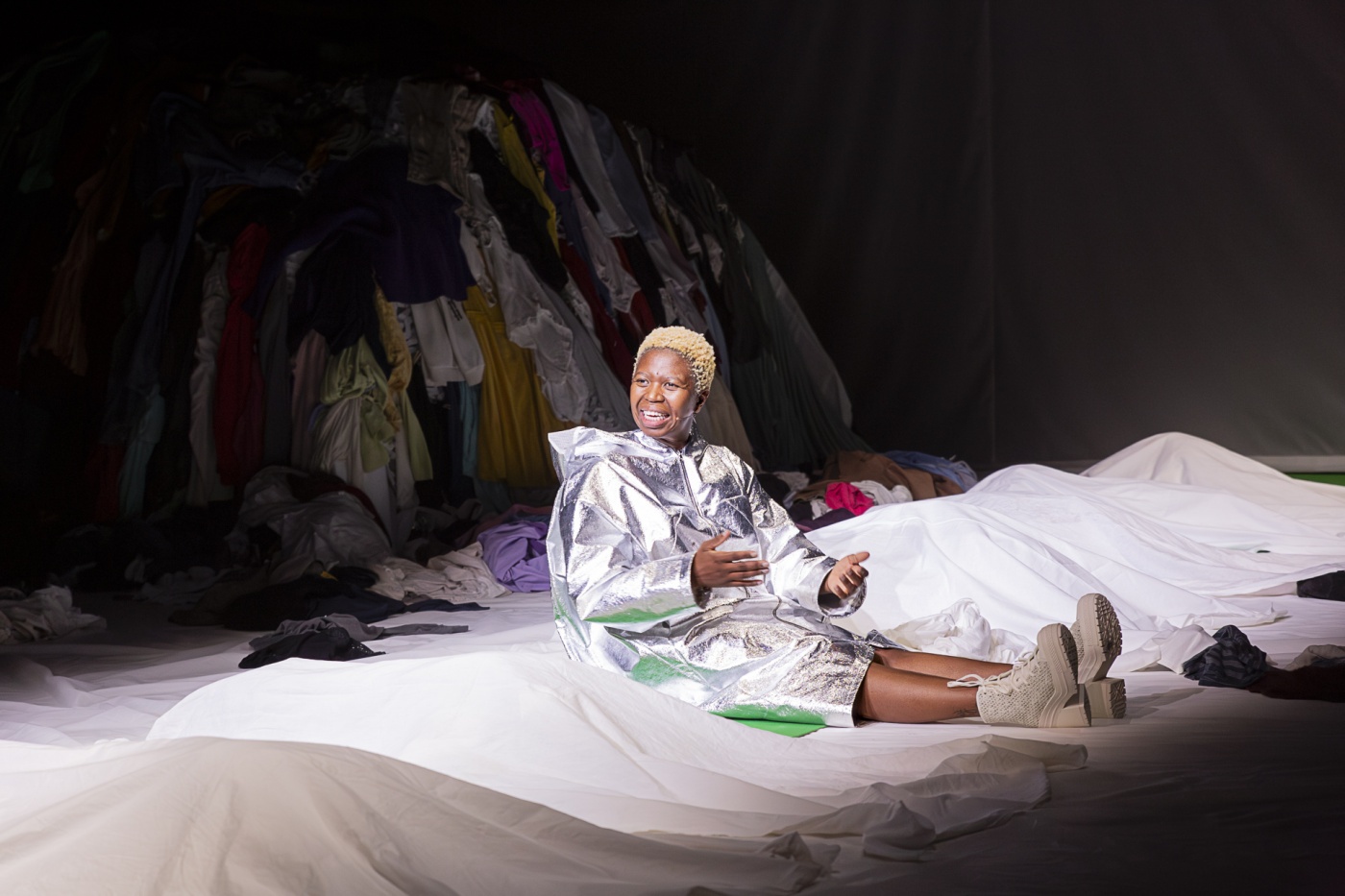
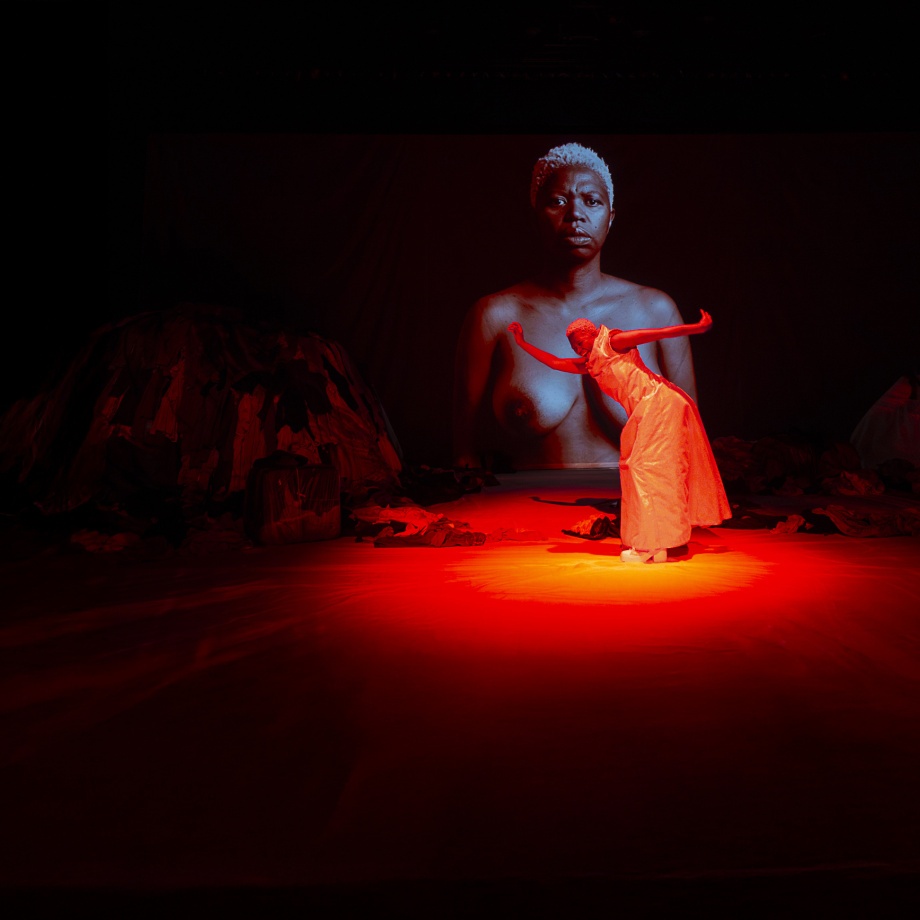
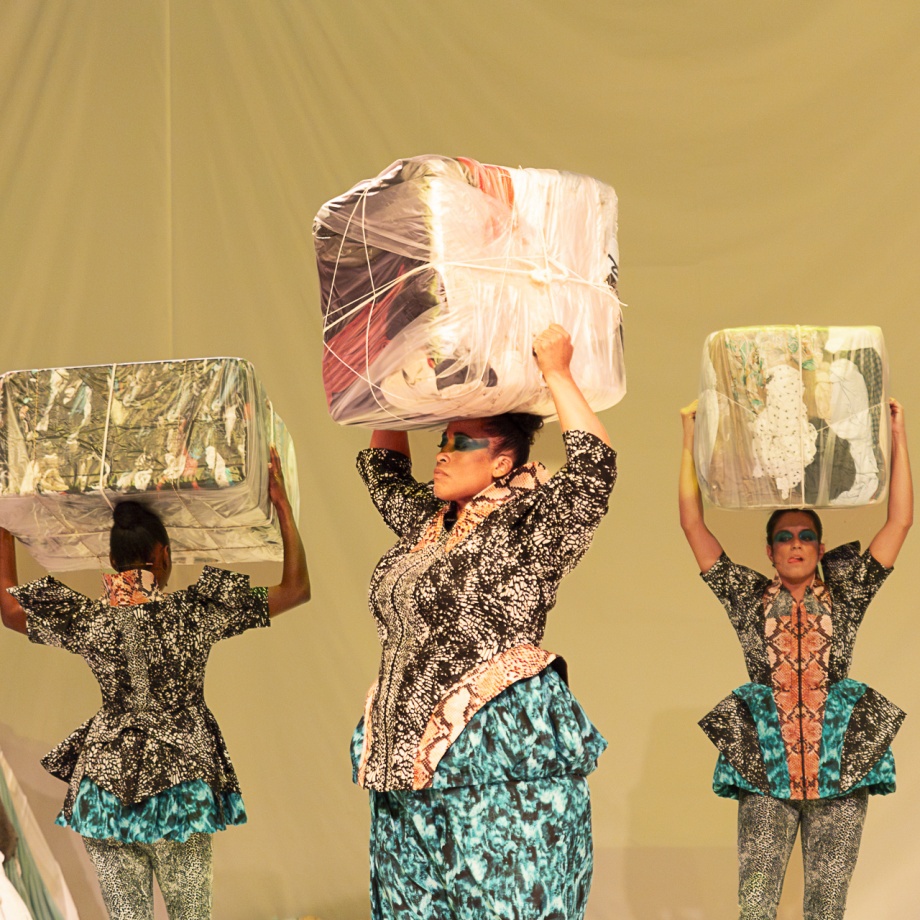
In co-presentation with Kaaitheater, KVS hosts Ntando Cele for two performances in the KVS BOX. In Wasted Land, she invites us to reflect on fast fashion as one of the many manifestations of neocolonialism. Theatre, dark humor, choral singing, and video come together in a post-apocalyptic satire on the inevitability of the climate crisis. The performance is based on decolonial laments and protest songs, reworked in collaboration with Egyptian musician and composer Wael Sami Elkholy, and inspired by T. S. Eliot’s poem The Waste Land (1923). The company previously shared their artistic vision at Théâtre Vidy-Lausanne.
PRESENTATION by the company
ast fashion connects the West — which consumes according to ideals of the “good life,” comfort, and various certifications of non-toxicity — with developing countries that produce at low cost and, in return, are burdened with globalized waste. To make this complex relationship between humans and waste visible, Ntando Cele draws, among other things, on queer ecology and contemporary sociological and scientific research.
Wasted Land orchestrates a melodic landscape that moves between theatrical performance, video projection, and poetic concert.
As a director and performer, Ntando Cele has often used theatre, music, and pop culture to expose latent forms of racism and stereotyping.
We cannot adapt to starvation. We cannot adapt to extinction.We can’t eat coal. We can’t drink oil. We will not give up.
CONTEXT : THE COLONIALISM OF WASTE
Approaches to tackling climate change are still predominantly developed and perceived from the perspective of the Western world, despite claims that it is an international problem. The global economic models that have made the Western world incredibly wealthy are accompanied by ideological maxims that seek to “save our world”, a form of neo-colonialism that does not speak its name.
The absurdities of this schizophrenic approach to solutions to global problems are starkly illustrated by the fashion industry, and particularly fast fashion, which, according to UN figures, is responsible for 10% of global CO2 emissions, 20% of toxic waste water and 9% of microplastics in the oceans. The major companies that sell fast fashion in the Western world practise “greenwashing” by, for example, encouraging their customers to return used clothes to shops in exchange for vouchers.
As a result of these exchanges, mountains of clothes are partially incinerated and piled up in huge landscapes where nothing now grows, in Chile, Ghana, Kenya, Indonesia and many other countries. Microplastics from synthetic and mixed fibres end up in the oceans, where they radically damage ecosystems.
GREENWASHING
So while consumers in Europe feel good about recycling and returning their clothes, in poor countries whole swathes of land are devastated, habitats and the environment destroyed. Wasted Land establishes a link between climate change (waste production) and oppression (colonialism), as these issues are often considered to be as disconnected as they are unsolvable. The performance is deeply sceptical about the possibility of fundamental change or restructuring society, given the entrenched power structures that maintain the status quo of the fashion industry’s hyper-capitalist system.
Can we imagine a world in which societies would stand in solidarity against the injustice and oppression of all humans, non-humans and the Earth?
Since we live in a highly racialised world, there is no point in continuing to advocate for solutions such as development aid and forced diversity, because these changes will only ever marginally benefit the people they are supposed to help. What would it mean to truly dismantle colonial structures? What is climate justice outside of recycling, religious veganism or barely verifiable eco-labels?

DESPAIR VERSUS DESIRE
If we were to rely solely on scientific prognosis, there would be little hope. That is why climate change should not be viewed solely from a scientific perspective. The scientific and economic view of the world is undoubtedly part of the problem, because it creates injustices in other communities. Indigenous peoples, on the other hand, have always lived in complex ecosystems and have succeeded in providing nuanced responses to their relationship with their environment.
Through performance, humour and song, Wasted Land attempts to expose the consequences of climate change by including the voices and ideas of the members of the communities that suffer its effects most, rather than viewing these communities through the prism of destitution and despair.
The music, poetry, whimsy, celebration, and sound of Wasted Land re-weave lost connections and seek direct emotional access to abstract entities such as “the environment”, “nature” or “the planet”.
Art can be a means of de-alienating our relationship with what surrounds us. Theatre can be a tool for creating a vision that moves away from one-dimensional stereotypes to share ways of being that are full of human contradictions, desires, wisdom, and the need to belong.
Photo credits: © Claudia Ndebele