


The Garden of Earthly Disquiet
With The Garden of Earthly Disquiet, Grace Tjang – starting from her own traumatic history – explores the story of all mothers who have been torn from their children in a heartbreaking way. It is an indictment of the colonial history that lies at the root of her personal trauma.
In search of primal emotions such as pain and sorrow, but also consolation and the ultimate joy of togetherness, Grace Tjang delves into so-called “forgotten memories,” where forgetting becomes a deliberate process because reality is too unbearable to face.
For "The Garden of Earthly Disquiet’’ Aya Suzuki has composed a new musical world for percussion. Starting from trance-like, cyclical patterns, she builds up layered soundscapes. Thanks to her warm, resonant idiom – inspired by the Indonesian roots of Grace Tjang – these have shades of gamelan music.
Suzuki's music is akin to a separate character, breathing life into Grace Tjang's world of memories and references. Her music transforms "The Garden of Earthly Disquiet’’ into a healing ritual.
For her most recent works, Grace chose to decolonise her name, adopting the name of her grandmother, Tjang, in honour of her grandmother and her family history.
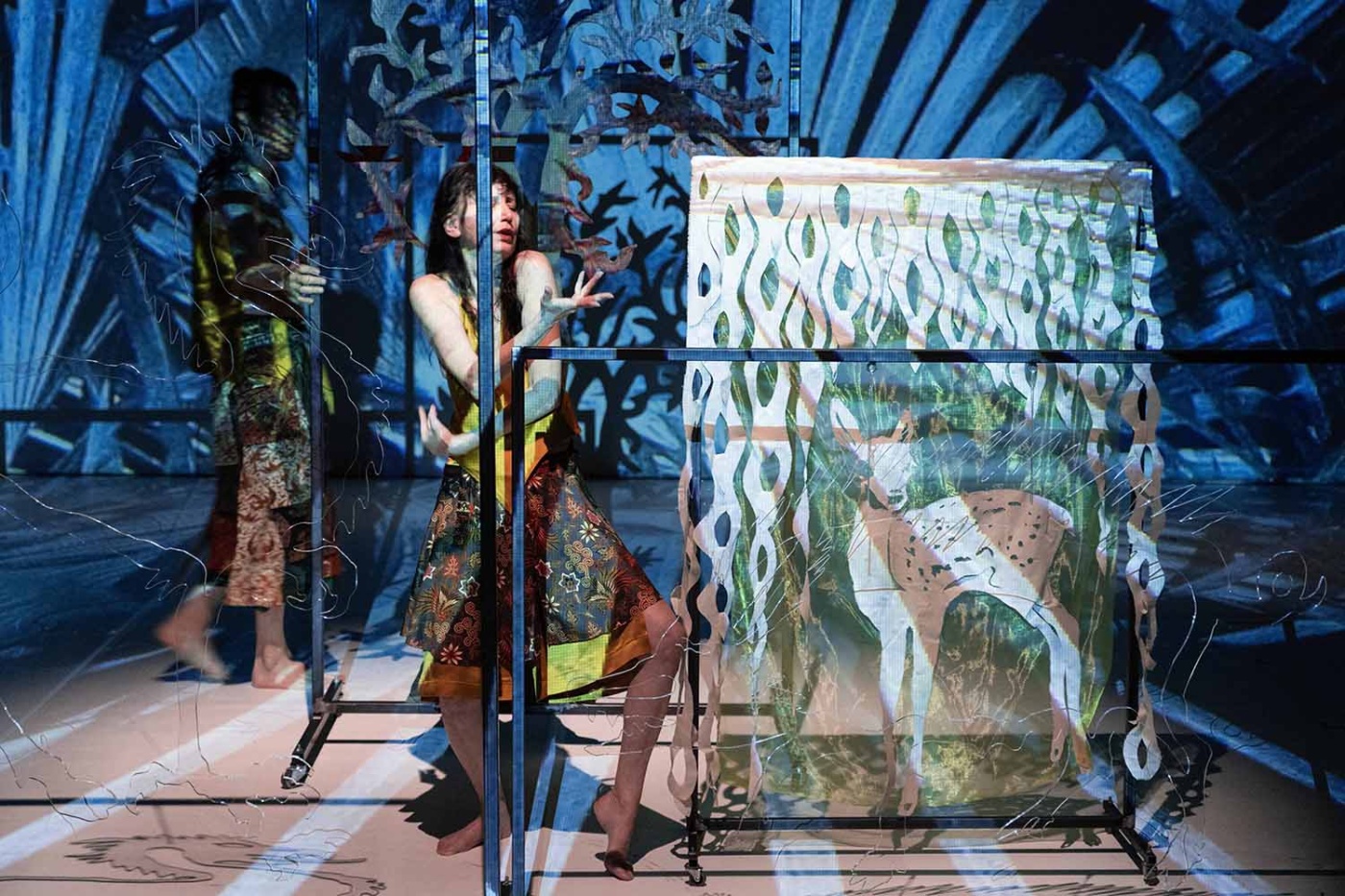
The body remembers
(by Robin Block)
Darkness falls in the tropical night
SUDDENLY
like an eye closing.
Darkness is a superb starting point from which to enter our memory. A liminal space. Somewhere between dreaming and waking. You allow your eyes to adjust to the darkness. To enter the half-lit forest of remembrance. To see whether by stamping on the ground you can summon the spirit of some ancestor. Your body tests the boundaries of a space, sometimes gently and hesitantly, sometimes playfully and shouting out with abandon, and then listening intently for who or what might respond in the distance. The voice of a lost ancestral mother, perhaps?
The disquiet in Grace Tjang’s (Grace Ellen Barkey’s) Garden of Earthly Disquiet consists of the distance from a loved one. The distance in time, in place; the distance between knowing and not knowing, and perhaps also between knowing and not wanting to know. All manner of things wash up in this wondrous garden: fragments of poetry, old photos, video footage and hypnotic sounds. The performers attempt to construct something tangible out of the wreckage, to reconstitute a suppressed memory.
As a spectator, you are overwhelmed at times, sometimes you discern specific patterns, and sometimes it feels akin to experiencing a lucid dream. Just like remembering, dreaming demands a kind of reverse engineering: you start with what is fresh in your memory, what you can most clearly recall, and then you hope that along the way more images, impressions, hidden details and forgotten events will float to the surface. As if you are pulling a thread towards you from out of the murky seawater until there is something recognisable attached to the end, or at least an object that tells you more about how deep exactly the bottom lies hidden. You also hope that no monsters emerge from the waves.
‘I am angry!’ said the little boy to the sea.
His mother gave him a magic potion to forget her.
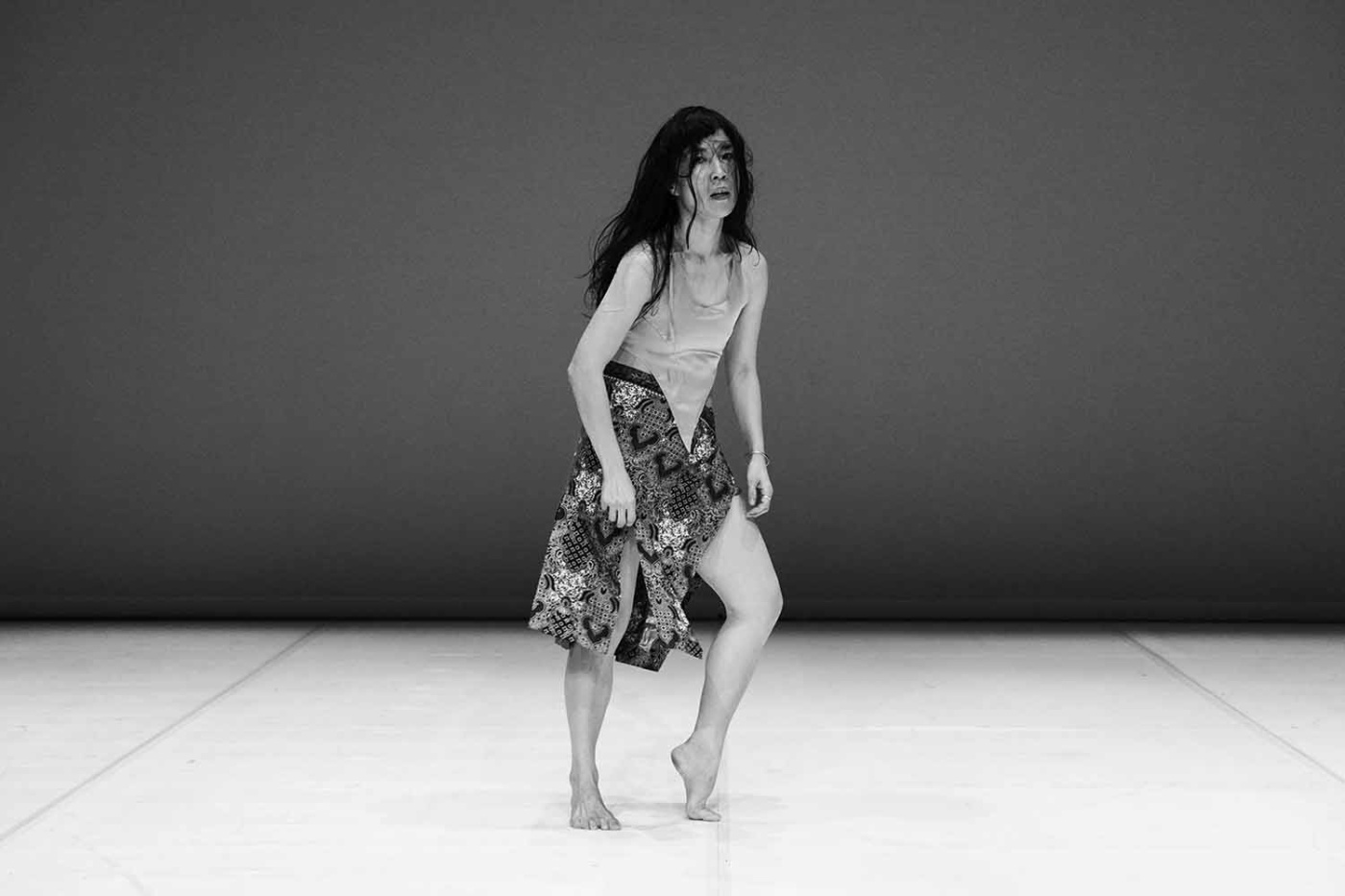
As a child, Grace Tjang’s father was given a ‘magic potion’ by his mother. To forget that he would be torn away from her: a sip and a spell to block out the pain of the forced farewell. It is well known that many victims do not like talking about their traumatic experiences, prefer not to break them open; partly because they do not wish to relive the pain and powerlessness that this engenders, but also because they do not wish to burden their offspring. What’s more: for some, their very survival stems from their ability to let go. And yet, the questions that remain unanswered still haunt our systems and seek a way out, whether we like it or not, for example in fairy tales.
In Grace’s father’s case, the magic potion was wonderfully effective. He did what was asked of him and found it easy to forget. Or did he? The child’s spirit let go, but the body stored up the traces. Psychiatrist and trauma specialist Bessel van den Kolk expresses the deeply held view that ‘The body keeps the score’[1]. His colleague and poet Rutger Kopland once described depression as ‘living with a closed future’[2]. Can we also claim the opposite about our painful, deeply buried memories? Is trauma like living with a sealed past? For what is trauma other than standstill, a frozen moment that constantly repeats itself and thus drills ever deeper into our soul?
Our body is an archive; in it we store fear and pain, but also our love and desires. How do you repair the broken thread with a mother? How do you make contact with someone who operates outside your sphere of influence? Or is this person already hiding somewhere within you?
In any case, remembering is as much a question of embodying, with a ‘memory body’ comprised of ears, eyes, fingertips, shoulders, aromas, sounds, voices and movements. In The Garden of Earthly Disquiet, Grace Tjang deploys all these senses. She breaks open her own memory – and that of her father – in an attempt to repair the lost bond with her ancestral mother. Sometimes this bond is very close and tangible, touchable like a skin, a scent in a neck that you can inhale in short bursts, then it becomes fluid and fitful again, it flows past us in waves, it streams in between our fingers, it drowns us and drips off us, only to reappear chilly and ungraspable in a witness statement or a single word: ‘nothing’.
To remember is to enchant and to disenchant; to simultaneously know and not (want) to know; to tentatively bridge the gap between the romanticised stories fed to you as a child on the one hand, and the indiscussable taboos on the other. Do we tell our children and grandchildren fairy tales to conceal a painful truth, or rather to render tangible a deeper meaning which would otherwise be intangible? Both, probably. Indeed, it is also the fairy tales that expose where the blind spots lie in our wider writing of history, and where we collectively fumble in the dark or deliberately look away. Hidden in our fairy tales is the deeply human desire to create a meaningful and relatable story out of this incomplete multiplicity of names, dates, places and events.
But how do you do that if the bloodlines have been severed, borders have been crossed, and holes have been shot in the tradition? As our need for meaning is far greater than what can concretely be found in the archives, the American cultural historian Saidiya Hartman introduces her method of critical fabulation[3]. In so doing, she as a researcher has given shape to her desire to bring to the surface what has been institutionally suppressed; to give a voice to those who have been forced to remain silent; to give a place to those who find themselves, willingly or unwillingly, in the margins of the dominant historiography. Where our factual knowledge falls short, we supplement this with educated guesses based on research; and as soon as those have reached their limits, we draw upon our intuition and imagination. This is the exact same process that Grace Tjang goes through with her performance.
History does not solely consist of facts and answers. It is not static; it changes with the questions we pose in the present, with how our bodies approach it, with how we plant a desire and witness what emerges from the ground.
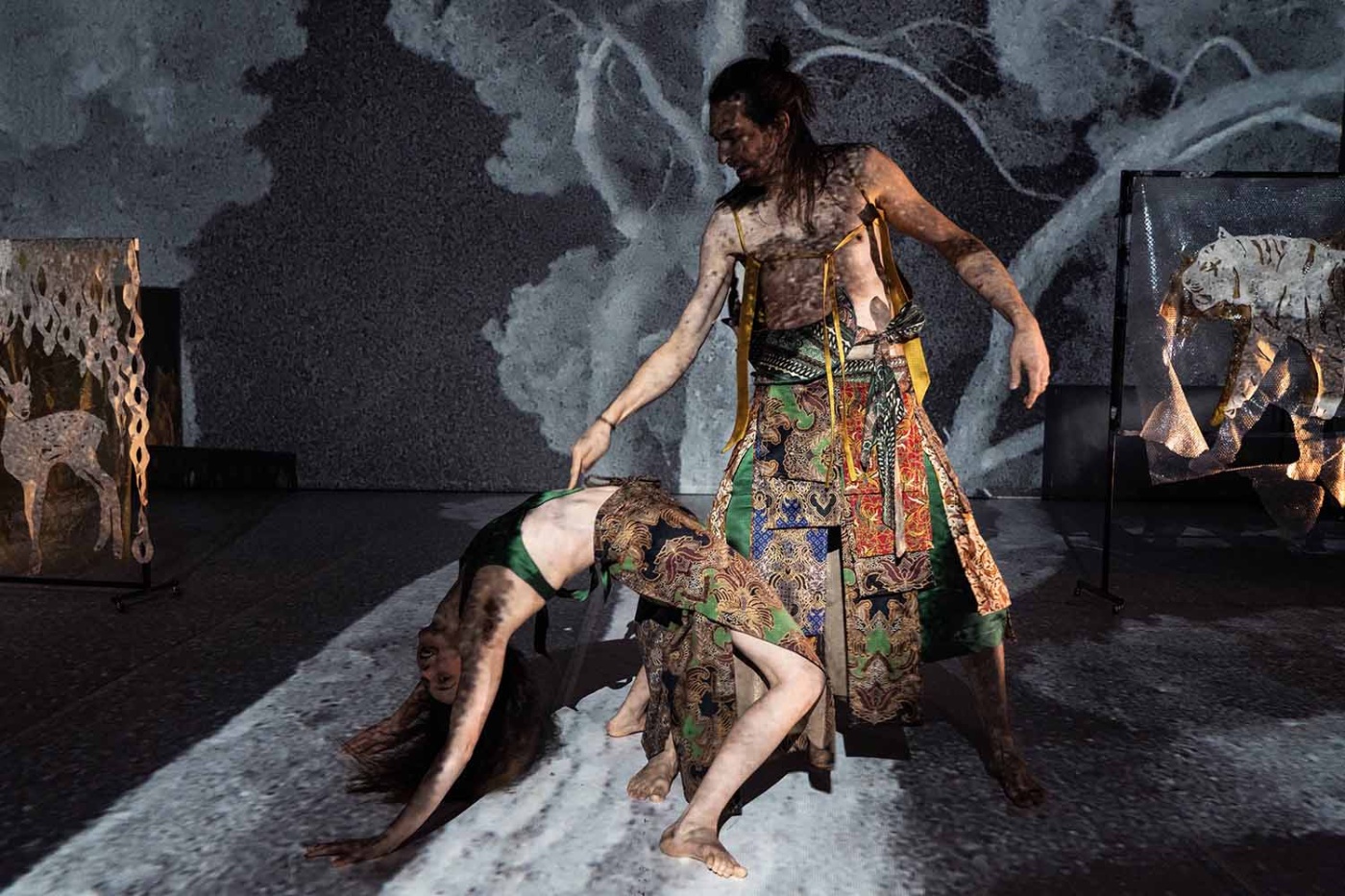
Not only does Grace Tjang go back in time; time itself becomes stretchable. Jam karet, ‘time is made of rubber’, it is often said in Indonesia, because time gone by is something different to time being experienced; there is the distance in measurable clock time, and there is slowed-down time in search of closeness, of an encounter, a point of contact. With this stretchable time, the space in which the memory plays out becomes bigger or smaller, unbridgeable or close at hand. In Grace Tjang’s performance, memory is a field, a resonance: each time a note is struck, something else resonates with it in another part of the space. We experience this intensely in The Garden of Earthly Disquiet. Just like with Indonesian gamelan music, the sounds constantly slow down and speed up. They repeat themselves compellingly and fall apart again in broken rhythms, or a single resounding cry: ‘Ibuuuuu’. Mother.
The moment you embrace this mother, she squirms out of your grasp. The moment you let her go, she crumbles into scents, children’s voices, movements that you have never previously made, yet still recognise; in waves of images, echoes of words that someone once spoke to you, the scent of earth, the colour of leaves. All these fragments constantly confirm that there is and will remain a distance: that something has fallen apart; that a diaspora has taken place; that families have been torn to pieces; that birthplaces and loved ones have been forcibly left behind. At the same time, there is also the comfort of what still remains and of how different aspects of that ancestral mother keep appearing. Will we succeed in constructing her face from all these shards?
Perhaps making contact is enough. After all, she is already in you. You emerged from within her, didn’t you? We are shaped from the same matter, aren’t we? It is precisely the disquiet in The Garden of Earthly Disquiet that constitutes the call to action. Sometimes we step fully into the experience, relive and embody it; sometimes we step out of it and leave it untouched. Thus history becomes a choreography; an ebb and flow of embodying and letting go again, of searching and cherishing, losing, retrieving, misplacing and reinventing. Because to remember is also to keep moving forward, in an active interplay between what is given to us and what we add or set aside. Out of all these sensory experiences we ultimately piece our story together, and from that story a human being re-emerges.
The body keeps the score. That much is certain, but the memories are not only dragged along in the form of trauma; they are also borne by the hands of subsequent generations. What other way is open to us to love with our bodies? That is where the transformation and growth lie. The committed act of remembering evokes our self-healing ability. It is precisely in diaspora stories that the entire community shows resilience by interconnecting. Children and grandchildren will face the darkness, breathe life into the past, and reshape it in the here and now. Their hands grasp one another, not only to keep each other going, but to set one another in motion again. Thankfully, we are not alone; we carry one another.
- Van der Kolk, Bessel A. The body keeps the score: brain, mind, and body in the healing of trauma. Penguin Books (2015). ISBN9780143127741.
- De Revisor. Volume 4. Athenaeum-Polak & Van Gennep, Amsterdam 1977.
- https://warwick.ac.uk/fac/arts/history/research/centres/blackstudies/venus_in_two_acts.pdf
The Garden of Earthly Disquiet
Concept, video & decor Grace Tjang
Choreography Grace Tjang
Music Aya Suzuki
Performers Sung Im Her, Aya Suzuki, Martha Gardner, Maarten Seghers & Grace Tjang
Dramaturgy Elke Janssens
Sound Bart Aga
Light Astrid Vansteenkiste
Production manager Rune Floryn
Costumes Seeligmüller
Assistance costumes Simon Perotti
Intership assistance to the director Liia Kosolovska
Artistic assistance Image Emma van der Put
Translation Anne Vanderschueren (FR) Vicky Morrison (EN) Nurhayo Santoso (ID)
Thanks to Oscar van der Put, Eka Santi Dewi & Romy Louise Lauwers
Production Needcompany
Co-production Perpodium, BNP Paribas Fortis Film Finance
With Support of Tax Shelter & the Flemish authorities